Patricia Snow: Dismantling the Cross

In this month’s print edition of First Things, there’s an insightful essay on celibacy by Patricia Snow, called “Dismantling the Cross: A call for renewed emphasis on the celibate vocation.”

[I]n our culture, and increasingly in the Church itself, marriage is not regarded as a means but an end. It is not considered a relative but an absolute good, and therefore a right. The usual solution or sequel to widowhood or divorce in our day isn’t a late religious vocation or a salubrious solitude, but more marriage, or more venery in Roger Angell’s phrase in a recent essay in the New Yorker: “More venery. More love; more closeness; more sex and romance. Bring it back, no matter what, no matter how old we are.” In a climate like this—a climate for which the Church bears a certain responsibility, given her abuse of the grace of celibacy and her disproportionate enthusiasm for marriage—what does the Church say to homosexual persons who wish to marry? What does she say, for that matter, to the invalidly remarried who want to receive the Eucharist and are dumbfounded by the suggestion that they forgo sexual relations in order to do so? Should we be surprised that in a culture that so privileges marriage over celibacy, many Catholics now assume that the Eucharist is ordered to marriage rather than the other way around—that the choice for marriage is primary, in other words, and the ­Eucharist simply a secondary enhancement?

Once marriage is understood to be an absolute good and a right, it becomes very difficult to explain why, in certain circumstances, the goods of marriage have to be set aside. When the Church herself doesn’t value celibacy at its true value, it is all but impossible to recommend celibacy to others. The less robust and exemplary the celibate example in the Church, the more the idea spreads that the choice for God costs nothing. The less celibacy is apprehended and lived as a grace, the more it begins to be thought of as a punishment.

Read the whole essay at First Things.

Frederica Mathewes-Green: A Sacrifice for a Friend

Frederica Mathewes-Green

Frederica Mathewes-Green is an award-winning Antiochian Orthodox author and lecturer, married to an Orthodox priest [full bio here]. The following was published on her website on March 13; we repost it here with her generous permission. 

I recently received an email from a young man, an Orthodox catechumen, who is concerned about his best friend. This friend recently came out as gay and, after being scolded by family and church friends, has joined an “affirming” church that will endorse his choices.

The young man writing to me said he was encouraged by something in one of my podcasts. I had said that there is room in our faith for people of the same sex to form loving relationships. This kind of love is called “friendship.” It has always been held in honor, and appears in the Bible and throughout Church history. It can be found between two siblings, or between people who met as children, or as adults. Same-sex, non-sexual love is unlike romantic love in that it doesn’t include a sexual component, but it can be every bit as strong. It is to our loss that the concept of nonsexual friendship love has largely vanished. Those bonds between men and men, and between women and women, run strong and deep, and are foundational to society.

We can see life-long, same-sex friendships among many pairs of the saints, for example St. Sophronius (AD 560-638) and St. John Moschus (AD 550-619), whose feast was March 11. While still in their twenties these young men set out on pilgrimage through Egypt, Sinai, and Palestine. They wanted to see and hear the wise elders of the desert, and the book they wrote, The Spiritual Meadow, is a treasure of the early church. The two men were companions until death, and St. Sophronius fulfilled St. John’s final wish to be buried in Jerusalem.

Continue reading

A Simple Reason to Get Married: “We Were in Love”

Nate and Sara CollinsMost same-sex attracted Christians who embrace a traditional Christian sexual ethic will remain celibate. Some, however, choose to pursue marriage with someone of the opposite sex. We’ve written about such marriages on Spiritual Friendship before, and last week we invited Mike Allen to share his story. This week, we wanted to share an interview with Nate and Sara Collins that was originally done by Preston Sprinkle for his blog, Theology in the Raw.
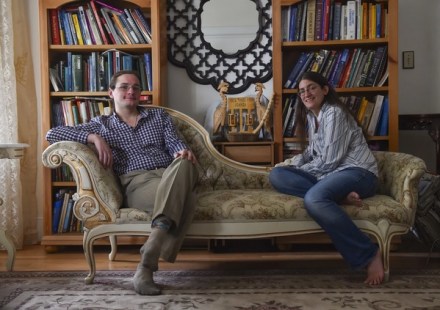
As Nate makes clear, nobody should use this kind of story to prescribe an opposite-sex marriage for all LGB Christians. When people feel pressured to hide their orientation and enter marriage, the results can be devastating. But there are many different ways of living a life that is faithful and pleasing to God, and we want give voice to that variety. — Ron Belgau

Preston Sprinkle: Thanks, Nate and Sara, for being willing to answer some questions! Sara, we’d first love to hear from you. What did you think when Nate first told you about his sexuality?

Sara Collins: Nate told me about his same-sex attractions about three months after we started dating, and I remember telling him that I was surprised, but not surprised at the same time.  It wasn’t something I had expected to hear from him, but I knew that all of us, myself included, have life experiences that present unique challenges. Everybody has a story, and this was his.  I also had a lot of questions and fear, but I knew that I was already in love with him, and hearing about his same-sex attractions didn’t change the fact that I still wanted to be with him.

Continue reading

Washington Post: Gay Christians choosing celibacy emerge from the shadows

Despite encountering criticism, the LGBT community is finding greater acceptance, even in religious circles

Josh Gonnerman and Eve Tushnet, both of Washington, are shown on Oct. 22 in the District. Gonnerman and Tushnet are gay and choosing the path of celibacy. (Ricky Carioti/The Washington Post)

Josh Gonnerman and Eve Tushnet, both of Washington, are shown on Oct. 22 in the District. Gonnerman and Tushnet are gay and choosing the path of celibacy. (Ricky Carioti/The Washington Post)


The Washington Post has recently published a story by Michelle Boorstein that talks about celibate gay Christians:

When Eve Tushnet converted to Catholicism in 1998, she thought she might be the world’s first celibate Catholic lesbian.

Having grown up in a liberal, upper Northwest Washington home before moving on to Yale University, the then-19-year-old knew no other gay Catholics who embraced the church’s ban on sex outside heterosexual marriage. Her decision to abstain made her an outlier.

“Everyone I knew totally rejected it,” she said of the church’s teaching on gay sexuality.

Today, Tushnet is a leader in a small but growing movement of celibate gay Christians who find it easier than before to be out of the closet in their traditional churches because they’re celibate. She is busy speaking at conservative Christian conferences with other celibate Catholics and Protestants and is the most well-known of 20 bloggers who post on spiritualfriendship.org, a site for celibate gay and lesbian Christians that draws thousands of visitors each month.

Check out the whole story.

A Person Synonymous with Controversy

Editor’s Note: Last fall, after Calvin College invited Justin Lee and Wesley Hill to speak on campus, an undergraduate at another Christian college contacted Spiritual Friendship to thank us for trying to foster this conversation about homosexuality, chastity, and spiritual friendship. Although we do not normally publish anonymous pieces on Spiritual Friendship, I felt that his perspective should be heard by the faculty and administrators at Christian Colleges. So we invited him to share a bit about what the issue looks like from the perspective of a student who wants to be faithful to traditional Christian teaching at a Christian liberal arts college.

Ron Belgau


I lead the normal life of a liberal arts college student: I’m too over-committed to do any one thing completely effectively. I wake up 10 minutes before class (and make it on time!). I am involved with a social fraternity, work two on-campus jobs. I live a busy life filled with laughter, late nights up talking to friends, and unappetizing cafeteria food. Most days are normal.

Some days, though, it feels like my existence is synonymous with controversy. I say this because I’m a Christian who is predominately, but not exclusively, attracted to the same sex. I am a bisexual Christian who believes in the “traditional” (side B) Christian teaching on marriage and sexuality. I have seen at a distance and personally how controversial the existence of a person like me can become on a Christian college campus like my own.

Continue reading