Spiritual Friendship and Courage: On the Need for Variety in Ministry

[In the time since I wrote this post, I have learned of serious problems in Courage with respect to the sexual abuse scandal. Due to the failures of Courage leadership in responding to these problems, I no longer support the positive view of Courage I took in this post.]

This post is a somewhat tardy response to a question about Spiritual Friendship and Courage that Fr. Matthew Schneider asked last month:

First, the short, un-nuanced version: I think that each movement has something positive to contribute to the Church. Courage provides anonymous support groups, while Spiritual Friendship is more public and works toward the day when gay and lesbian people can receive all the support they need in their families and parishes. Both of us agree that friendship is important for those who are trying to grow in chastity. Like the Pope, Spiritual Friendship is comfortable using the word “gay” to describe attraction to the same sex, while many in Courage misunderstand and criticize us for this. Spiritual Friendship tries to talk about the difficult intersection between friendship and same-sex desire in a way that takes the Catholic moral tradition seriously. Some (though not all) writers at Spiritual Friendship have some reservations about the 12-Step model Courage uses. And we all disagree in varying degrees with the Freudian theories of causation that Courage has adopted, though we haven’t made attacking those theories a priority.

Now, the much longer, more nuanced version. (Because this is a large topic, this is, unfortunately, a long post. In order to make it a little bit easier, I have broken it up into sections addressing different parts of the discussion. It may be easier to come back to it and read it a bit at a time, rather than trying to read the whole article at once.)

Continue reading

Deacon Jim Russell and the Hermeneutic of Suspicion

Update (9/18/2015): In his reply to this post (see his comment below), Deacon Russell says, “we can meet any time, face to face, to charitably address and correct things. I’d be all for that.”

He goes on to say, “As it is, now and forever, here is my challenge to you, Ron. We are engaged in public discourse. In that framework, I will gladly defend all my assertions and positions of the last three years in a direct exchange with you. I will do so charitably and fairly in any number of formats, including live and in person, publicly or privately. This offer will not expire. God bless.”

On July 1, 2015, I invited Deacon Russell to meet face to face with Saint Louis Auxiliary Bishop Edward Rice mediating our conversation. He did not accept. My offer still stands.

Original Post: I rarely respond directly to Deacon Jim Russell; I generally find that there is so much “spin” in his posts that it is difficult to find a productive point of engagement. I usually have responded indirectly, trying to present Church teaching in a positive way that I hope clarifies some of the misunderstandings about Spiritual Friendship that I see in his writings. A couple of points he makes in a recent article, however, may deserve direct clarification (especially in light of the timing of his post and the amount of media attention focused on me because of the World Meeting of Families).

Dome of St. Peter's

The gist of my response is simple: despite Deacon Russell’s efforts at spin, there is nothing contrary to the Catholic faith in ideas like, “obsessing over sexual temptation is unhelpful,” “service to others is helpful in overcoming temptation,” and “friendship is an important avenue of support and intimacy” for those seeking to live a chaste life. But since these straightforward claims have sparked Deacon Russell’s critique, I am taking the time to respond to his criticism at length.

Continue reading

Love, Covenant, and Friendship

In my previous post, I drew attention to the way the Catholic Church frequently references friendship in her pastoral advice related to homosexuality. In this post, I want to examine the nature of friendship itself more deeply, particularly as it relates to two other crucial Biblical concepts: love and covenant. The relationship between love and covenant will be obvious to most contemporary readers; the connection between covenant and friendship, however, is frequently neglected in contemporary Christian teaching.

Cathédrale_d'Auch_20

If we examine the Bible, however, this neglect should surprise us. Each of the three most important covenants in salvation history is characterized by friendship between God and the human representatives—Abraham, Moses, the Twelve Apostles—to whom He entrusts the covenant. Abraham, the great father of all who share his faith (Romans 4:16) is also called a friend of God (2 Chronicles 20:7; James 2:23). God “spoke to Moses face to face, as a man speaks to his friend” (Exodus 33:11). And at the Last Supper, on the night when Christ instituted the new and eternal covenant, He said to the Twelve, “No longer do I call you servants, for a servant does not know what his master is doing; but I have called you friends, for all that I have heard from my Father I have made known to you” (John 15:15). He also frames His own sacrifice on the cross—the definitive act in salvation history—as an act of friendship: “Greater love has no man than this, that he lay down his life for his friends” (John 15:13). By calling His disciples friends, Jesus led Thomas Aquinas to conclude that charity (the Latin equivalent of agape love in New Testament Greek) was identical to friendship (Summa Theologiae IIa-IIae 23.1).

If we want to understand what God meant when He made covenants with His people, it’s important to understand what a “covenant” meant in the culture that God first spoke to. The most extensively described human covenant in the Bible is the covenant friendship between David and Jonathan (1 Samuel 18:3). For this reason, a significant portion of this post will focus on their relationship, which not only helps us to understand the connection between covenant and friendship at the human level, but also should help us to understand the connection between friendship and covenant in our relationship with God. If we persevere in faith and love, we will ultimately see God face-to-face, as Moses did (1 Corinthians 13:12, compare with Exodus 33:11). True friendship can thus give us a glimpse in this life of the love that we will experience in its fullness in Heaven.

Continue reading

Friendship and Catholic Teaching about Homosexuality

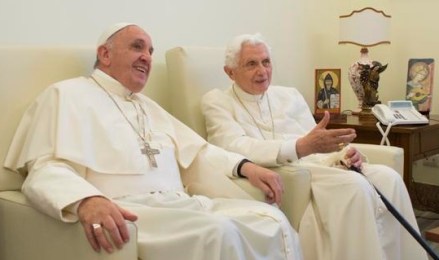
Popes Francis and Benedict

Friendship has been an important theme in the Catholic Church’s pastoral guidance regarding homosexuality. According to the Catechism of the Catholic Church (1992), which provides a comprehensive overview of Catholic teaching,

2359 Homosexual persons are called to chastity. By the virtues of self-mastery that teach them inner freedom, at times by the support of disinterested friendship, by prayer and sacramental grace, they can and should gradually and resolutely approach Christian perfection.

The Catechism also draws a more general connection between chastity and friendship:

2347 The virtue of chastity blossoms in friendship. It shows the disciple how to follow and imitate him who has chosen us as his friends, who has given himself totally to us and allows us to participate in his divine estate. Chastity is a promise of immortality.

Chastity is expressed notably in friendship with one’s neighbor. Whether it develops between persons of the same or opposite sex, friendship represents a great good for all. It leads to spiritual communion.

Continue reading

What is the Relationship between Experience and Revelation?

There’s been some recent discussion on Catholic blogs about the relevance of personal experience in conversations about how the Church can provide community and pastoral care to gay and lesbian Catholics who are seeking to be faithful to Church teaching. In order to answer this specific question, it’s worth examining the relationship between revelation and experience more generally.

John Paul II

The Theology of the Body is a collection of addresses given by Pope John Paul II in the late 1970s and early 1980s and addressed to understanding the body and human sexuality in light of the Gospel. In a footnote to the General Audience of September 26, 1979, he wrote:

When we speak here about the relationship between “experience” and “revelation,” indeed about a surprising convergence between them, we only wish to observe that man, in his present state of existence in the body, experiences many limits, sufferings, passions, weaknesses, and finally death itself, which relates his existence at the same time to another and different state or dimension. When St. Paul speaks about the “redemption of the body,” he speaks with the language of revelation; experience is not, in fact, able to grasp this content or rather reality. At the same time, within this content as a whole, the author of Romans 8:23 takes up everything that is offered to him, to him as much as in some way to every man (independent of his relationship with revelation), through the experience of human existence, which is an existence in the body.

We therefore have the right to speak about the relationship between experience and revelation; in fact, we have the right to raise the issue of their relation to each other, even if many think that a line of total antithesis and radical antinomy passes between them. This line, in their opinion, must certainly be drawn between faith and science, between theology and philosophy. In formulating this point of view, they consider quite abstract concepts rather than the human person as a living subject.

Continue reading

An Incomplete Thought about Beauty and “Sexuality”

Flight to ArrasI recently re-read Flight to Arras, Antoine de Saint-Exupéry’s memoir of his service as a French reconnaissance pilot during the German invasion of France in 1940. As his air group retreats before the advancing German forces, they are forced to live with local peasants.

One evening, after returning from a particularly dangerous mission, he sits down to dinner with the farmer he is staying with, the farmer’s wife, and their young niece. The farmer breaks bread and passes it around the table. Then Saint-Exupéry comments:

I looked at the beautiful niece beside me and said to myself, “Bread, in this child, is transmuted into languid grace. It is transmuted into modesty. It is transmuted into gentle silence. And tomorrow, perhaps, this same bread, by virtue of a single gray blot [German soldiers wore gray uniforms] rising on the edge of that ocean of wheat, though it nourish this same lamp, will perhaps no longer send forth this same glowing light. The power that is in this bread will have gone out of it.”

I had made war this day to preserve the glowing light in that lamp, and not to feed that body. I had made war for the particular radiation into which bread is transmuted in the homes of my countrymen. What moved me so deeply in that pensive little girl was the insubstantial vestment of the spirit. It was the mysterious totality composed by the features of her face. It was the poem on the page, more than the page itself.

The little girl felt I was looking at her. She raised her eyes to mine. It seemed to me that she smiled at me. Her smile was hardly more than a breath over the face of the waters; but that fugitive gleam was enough. I was moved. I felt, mysteriously present, a soul that belonged in this place and no other. There was a peace here, sensing which I murmured to myself, “The peace of the kingdom of silence.” That smile was the glow of the shining wheat.

The face of the niece was unruffled again, veiling its unfathomable depth. The farmer’s wife sighed, looked round at us, and spoke no word. The farmer, his mind on the day to come, sat wrapped in his earthy wisdom. Behind the silence of these three beings there was an inner abundance that was like the patrimony of a whole village asleep in the night—and like it, threatened. Strange the intensity with which I felt myself responsible for that invisible patrimony. I went out of the house to walk alone on the highway, and I carried with me a burden that seemed to me tender and in no wise heavy, like a child asleep in my arms.

Continue reading

Spiritual Friendship and Julie Rodgers

Julie RodgersJulie Rodgers blogged for Spiritual Friendship between August, 2013 and October, 2014. Prior to that, she had spent a decade with Exodus International, serving as a keynote speaker at the final Exodus Freedom Conference in 2013. Until this past Monday, she also served in the Chaplain’s Office at Wheaton College, counselling students who were struggling with sexual orientation or gender identity issues.

On Monday, Julie resigned from Wheaton and put up this blog post. The post was mostly a cri de cœur about the damage done by conservative Christians who bind heavy burdens on LGBT people—particularly youth—without doing much to help. But she also wrote, “Though I’ve been slow to admit it to myself, I’ve quietly supported same-sex relationships for a while now.”

Although I spoke with Julie briefly as recently as a week before she put up this post, I had received no indication at all that her views were shifting, and did not learn of it until a friend drew my attention to her post Monday afternoon.

Julie is right that conservative Christians have done a bad job of showing Christ’s love to LGBT people.

Continue reading

What Does “Disinterested Friendship” Mean?

Popes Francis and Benedict

The Catechism of the Catholic Church uses the term “disinterested” in five different places. The most relevant instance for most readers of this blog is:

2359 Homosexual persons are called to chastity. By the virtues of self-mastery that teach them inner freedom, at times by the support of disinterested friendship, by prayer and sacramental grace, they can and should gradually and resolutely approach Christian perfection.

The first definition for “disinterested” at Dictionary.com is “unbiased by personal interest or advantage; not influenced by selfish motives,” which would mean that a “disinterested friendship” is a friendship that is not biased by personal interest or advantage, nor influenced by selfish motives. In the context of 2359, the most obvious selfish motive in view would be lust, though any selfish motive will poison friendship. This unbiased and unselfish friendship seems like the sort of love most of us would want from our friends.

However, the second definition for “disinterested” is “not interested; indifferent.” A usage note points out that

Disinterested and uninterested share a confused and confusing history. Disinterested was originally used to mean “not interested, indifferent”; uninterested in its earliest use meant “impartial.” By various developmental twists, disinterested is now used in both senses. Uninterested is used mainly in the sense “not interested, indifferent.” It is occasionally used to mean “not having a personal or property interest.”

And, this confusion infects many people’s understanding of the term “disinterested friendship” in 2359. To many, “disinterested friendship” suggests a friend who is “not interested, indifferent.” Comparison with other usages of the same word in the Catechism, however, demonstrates that this cannot be the sense the authors of the Catechism had in mind.

2649 Prayer of praise is entirely disinterested and rises to God, lauds him, and gives him glory for his own sake, quite beyond what he has done, but simply because HE IS.

Continue reading

Awe and Wonder: A Preliminary Comment on Laudato Si’

Pope Francis

Laudato Si is shaping up to be the most controversial papal encyclical since Humanae Vitae. On the surface, the dissent from these two encyclicals seems very different: the rebellion against Humanae Vitae came from the political “left,” while the present rebellion comes from the “right.” If, however, we dig beneath the shallow political categories, we find that the two rebellions are “ultimately due to the same evil: the notion that there are no indisputable truths to guide our lives, and hence human freedom is limitless” (LS, 6).

The “left” has focused more on sexual freedom, and the “right” on economic freedom. The fundamental question for both, however, is: can we discover a rational order in nature, put there by God, an order to which we are called to conform our lives? Or do we see in nature—including our own human nature—only raw materials to be exploited for ends that we choose for ourselves?

In Romans 1 and 2, the Apostle Paul makes clear that even without direct revelation, it is possible to learn of the Creator through Creation itself, and to discover His law written in our hearts. But most of us do not really want to discover these truths; instead, we want to serve our own desires.

How, then, can we begin to recover the harmony of Creator and creation described in Genesis 1 and 2?

Continue reading

Joseph Ratzinger and Rowan Williams: Contraception and Same-Sex Marriage

Last week, I linked to a post by Abigail Rine at First Things, which argued that Evangelicals tended to trivialize the importance of procreation in their theology of marriage, and that by doing so, they made it more difficult to articulate a coherent objection to same-sex marriage. This post follows up and expands on that discussion.

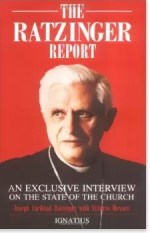
The Ratzinger Report

In 1985, Cardinal Ratzinger (now the Pope Emeritus) gave a book-length interview to the Italian journalist Vittorio Messori (published as The Ratzinger Report). The interview was wide-ranging, covering most of the challenges facing the Church. Naturally, Messori asked Ratzinger to talk about the challenges facing the Church’s sexual ethic.

In 1989, Rowan Williams, a prominent Anglican theologian who would later become Archbishop of Canterbury, gave a lecture to the Lesbian and Gay Christian Movement that was later published as “The Body’s Grace,” [pdf] arguing for the legitimacy of gay and lesbian relationships.

Ratzinger and Williams are among the best theologians of their generation, and each went on to lead his respective communion. As is to be expected, they hold differing views on contraception: Williams follows Anglican teaching in believing married couples can use contraceptives, while Ratzinger defends the Catholic teaching that they cannot.

What is interesting, however, is the similarity of their views about how the logic of contraception shapes our theological response to homosexuality: both believe that if you accept the legitimacy of contraception in marriage, it is difficult to argue against same-sex sexual intimacy.

Continue reading