
Thabiti Anyabwile on Church and Culture

Thabiti AnyabwileOver at the Gospel Coalition, Thabiti Anyabwile has a thoughtful post asking whether Christians are prone to over-compensate for cultural losses, which echoes some of the concerns over politicizing the Church’s witness that Aaron Taylor raised earlier this week. Anyabwile writes:

Or consider the current debates regarding same-sex issues. The church is perceived as “losing” on that issue and a good number of leaders are exercised about it. I’m not making light of their concerns and I share much of it. But when well-meaning leaders fall prey to the subtle temptation to make state legislation granting same-sex marriage rights a report card on the church, strange things can happen. Like the pastor who ceases his ministry of regular exposition to do a series on homosexuality. The series isn’t so much an exposition of key texts or a sensitive approach to discipleship in this area, but a jeremiad against “the culture” and a desperate ringing of the church bell to alert everyone to the impending doom. Public policy figures prominently in the sermons and in after church discussions. The pastor gets exercised. The church gets politicized. People get ostracized–and not just those who may be addressing same-sex desires in the course of their Christian discipleship.

The whole post is thoughtful, and offers some good practical advice for how to approach controversial issues in an informed, pastorally sensitive way. Since I criticized an earlier post by Anyabwile (and Spiritual Friendship also published a critique by Kyle Keating), I think it’s important to highlight when I think he really gets it right.

It’s a sad fact about the Internet that posts expressing criticism can easily go viral, while posts pointing out good thinking rarely get the same level of attention. Still, I want to do what I can to give credit where credit is due.
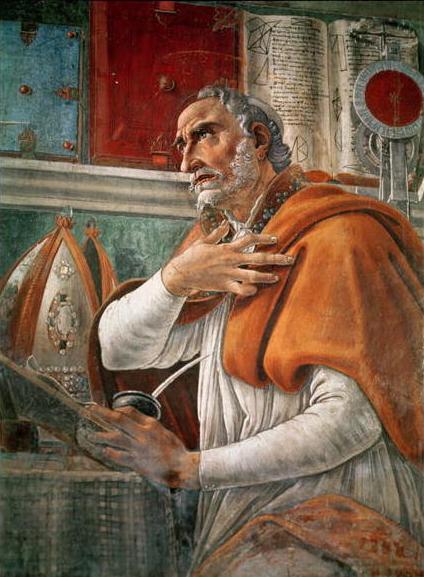
Faith and Seeking Understanding

Saint_Augustine_Portrait

Botticelli: St. Augustine

Christian faith is not the conclusion of an argument: it begins in some sense or other in a personal encounter with God. Some people experience this encounter in a dramatic way, for others, it is much gentler and quieter. But we believe because we believe God, who, in some way, speaks to us. This belief is more a matter of personal trust in the God who loves us and has revealed himself to us than it is the conclusion of an intellectual investigation.

We are created in God’s image, and God is love. Our faith is thus best nurtured by experiencing God’s love through prayer, worship, and the sacraments, by acts of service or contemplation that we do out of love for God, and by Christian community, where we love others and experience and are nurtured in love.

God also knows and understands everything, and our desire to understand Him and the world He has created is part of His image in us. Although belief and trust are primarily personal responses to God’s love for us, we also want to understand what we believe and who we trust. There are, moreover, parts of Christian teaching—like the Trinity, the Incarnation, or the virgin birth—that are difficult to understand. And Christian faith also gives rise to difficult questions: for example, if God is all knowing and all powerful, and He desires what is good for everyone, why is there so much evil and suffering in the world?

Continue reading

Why Did Paul Object to the Arsenokoitai?

My own beliefs about Biblical teaching on homosexual acts are relatively simple: the Jewish Law prohibited any sex between two men (Leviticus 18:22, 20:13). Paul renewed that prohibition in the New Testament (1 Corinthians 6:9, 1 Timothy 1:10) and taught that such acts are “contrary to nature” (Romans 1:27). The Church has always regarded homosexual acts as serious sins. Thus, for me, the primary questions are, “How do I obey this teaching?” or “How does this teaching harmonize with the importance of loving and being loved in the Gospel teaching more broadly?”

However, the range of possible controversies behind those relatively simple beliefs is vast. I wrote a little about this in my recent post on Pederasty and Arsenokoitai, and @ladenheart, a friend who knows the classics much better than I do, has written a thoughtful response. His post is rich, well worth reading, and raises too many questions for me to address here. I will make at least a partial response, however. Near the end of his post, he offers the following tentative conclusion:

My general sense – although I do admit, it is a work in progress – is that what the Judeo-Christian tradition is condemning when it speaks negatively of sexual acts between men are, demonstrable in most cases, acts that are based on exploitation, unequal status, or excess.

I agree with him that, if we really want to understand what the Apostle Paul and the subsequent Christian tradition were trying to say, we need to understand the cultural context that he was writing in. However, we also need to understand the mind with which he judged that world. My concern with @ladenheart’s post—and I raise this as a concern needing further discussion, not a conclusion—is that he focuses heavily on the historical details of ancient paganism, but then judges what he finds with largely 21st century eyes.

Continue reading

Pederasty and Arsenokoitai

One argument that is sometimes offered by Christian advocates of same-sex marriage is that the Apostle Paul was not thinking of loving, monogamous adult relationships, and only intended to condemn Greco/Roman pederasty. I’ve been spending a lot of time reading ancient Greek texts on sexuality recently, and that has gotten me thinking in general about Paul’s historical context and, more specifically, about this argument.

First, it’s important to acknowledge that relationships between adult men and adolescent boys or young men were the most commonly attested same-sex relationships in the ancient world. There are exceptions—Plato’s Symposium discusses committed, lifelong same-sex relationships—but this is by far the most common kind of relationship. We should therefore acknowledge that the Apostle Paul was likely most familiar with this kind of same-sex sexual activity.

It’s worth observing, however, that precisely because this form of same-sex sexuality was so common, there was standard terminology in Greek for talking about these relationships—the older man was the erastes (lover) and the younger man the eromenos (beloved). If these relationships were Paul’s target, it would have been reasonable for him to use these standard Greek terms.

Instead, he used an apparently novel term, arsenokoitai, which either he invented or which he took from Helenistic Judaism. The most logical derivation of this new word is from the Septuagint translation of Leviticus 18:22, which says that you shall not lie with (koiten) a man (arsenos) as with a woman.

Continue reading

The Problem with “Same Sex Attraction”

One view, which has many defenders among Christians who believe that homosexual acts are sinful, is that the term “same-sex attraction” is the clearest and most precise term for describing the experience of those who are, from time to time, tempted to commit homosexual acts.

However, the distinction between carnal and spiritual friendship makes clear that there are different ways of desiring union with a person of the same sex, some of which are virtuous and some of which are vicious. Unfortunately, the term “same sex attraction” introduces unnecessary confusion by lumping all of these desires in under one category.

Continue reading

Building Bridges at Pepperdine and Seattle Pacific

On April 13, Justin Lee and I did a joint presentation, Let’s Talk about [Homo]sexuality, at Seattle Pacific University. Like previous presentations at Pepperdine University and Gordon College, we shared a bit about our own stories, offered some practical tips for building bridges in the midst of disagreement. We also each presented a brief overview of our own beliefs about Christian sexual ethics, Justin arguing that Christians should bless same-sex marriage, and me arguing that they should not. Rachel Held Evans recently highlighted this as the “Best Dialogue” on sexual ethics.

Continue reading

Misty Irons on Ian Charleson

I watched Chariots of Fire again last night. It’s a powerful film that I’ve loved ever since I first saw it with a friend over 20 years ago. It has had a big influence on my understanding of discipleship and vocation (I discuss this a little near the end of my 2007 GCN Keynote speech). After I finished the movie, I was reading more about it online, and came across this 2011 blog post by Misty Irons, “Thoughts on Ian Charleson“:

I reChariots of Firecently realized that the movie Chariots of Fire, which I watched for about the fifth time last weekend, would have completely failed if it weren’t for the brilliant acting of Ian Charleson who played Eric Liddell. That may seem obvious: Eric Liddell’s character is the inspiration of the movie. He’s the Christian missionary who ran for God’s pleasure, who risked throwing away three years of training and a chance for Olympic gold because he felt he could not run an Olympic heat on the Christian Sabbath. 

People think it’s the story itself that captivates us, but I think it is Charleson’s performance that sells it. His job as an actor was not just to play a good man but a saintly man, pious yet likable, reserved but not dull, conflicted yet steadfast, vulnerable enough to draw our sympathy yet strong enough to stand entirely alone. Then he had to make it look so natural the audience would be tempted to think this guy Ian Charleson must just be playing himself; yet I can’t think of a more difficult acting role. One misstep and the whole thing is ruined: we’re left with a story about a self-righteous prig who’s determined to put the hopes of an entire nation on hold because of his personal fanaticism. The difference between that disaster and the Academy Award winning picture we got is Ian Charleson’s ability to hit exactly the right note.

I got curious about the man who was able to pull off this subtle, multi-layered, highly spiritual performance. I thought, “I really like this Charleson guy. I’ll bet he’s either Christian or gay.” I googled, then wikipedia-ed. Charleson was gay. And reading between the lines he was probably also Christian, judging from how eager he was to play the part of Eric Liddell, saying the role would “fit like a kid glove.” He studied the Bible intensively to prepare for the role and wrote the post-race speech Eric Liddell delivered to the working class crowd himself. Charleson died of AIDS in 1990. He was 40.

Read the rest at More Musings On.

Notre Dame Marriage Panel Follow-Up

Last Monday, I spoke on a panel on marriage at the University of Notre Dame. Here is an excerpt from the Irish Rover’s article on the event:

Ron Belgau is a graduate student in philosophy at Saint Louis University and founder of the website Spiritual Friendship. . . .

Belgau began the discussion by acknowledging that “debates over same-sex marriage are extremely polarizing.” As a gay Catholic who embraces the Church’s teachings on sexuality, Belgau emphasized the need for a positive pastoral example for men and women who have same-sex attractions. He noted the experience many people have of “homosexual sins [being] graded on a very different scale than heterosexual sins.” In light of this tendency for homosexuals to feel marginalized, Belgau noted the importance of discussing ways for these people to respond to God’s calling and to use their particular gifts within the Church, with a particular emphasis on spiritual friendship—understanding the Church’s teachings as offering a positive vocation for same-sex attracted people.

In contrast with the negative precept to not engage in “gay sex,” Belgau said that a deeper understanding of the Church’s teaching on chastity can provide a positive vision for same-sex attracted persons. To be chaste, Belgau explained, is “to be able to order our sexual desires in accordance with right reason, in accordance with the plan that God wrote into creation that is known through right reason but which is also revealed to us in the Church.”

Belgau concluded by discussing the importance of mercy as related through the St. Patrick’s Day Gospel reading. “If we respond to this call to bear witness in a way that recognizes our own sin, recognizes our own struggle, then we have a very different witness to give to our culture,” he said.

I’ll post video of the event when it becomes available. The whole article is worth reading.

Panel Discussion on Marriage at Notre Dame March 17

GrottoI will be joining Jennifer Roback Morse, founder and president of the Ruth Institute, and Sherif Girgis and Ryan T. Anderson, coauthors, with Robert P. George, of the book What is Marriage? Man and Woman: A Defense for a panel discussion on the role of the Catholic Church in the cultural and political debate about marriage.

The discussion, “Marriage, the Church and the Common Good,” is sponsored by Notre Dame’s Center for Ethics and Culture and several student groups and will take place at 7 p.m. Monday (March 17) in DeBartolo Hall, Room 101, on the campus of the University of Notre Dame.

According to Michael Bradley, a Notre Dame senior student who organized the event, “no cultural, legal or philosophical issues are gripping the nation as firmly as are the questions that comprise the marriage debate. What is marriage? Why does it matter? How should public policy reflect sound answers to these questions? What role, if any, should the Catholic Church play in the development of this discussion? Having four of the most articulate Catholic voices in the marriage debate gathered here to discuss these and other questions should be an unparalleled occasion to explore them in harmony with the Catholic tradition.”

The discussion is free and open to the public.