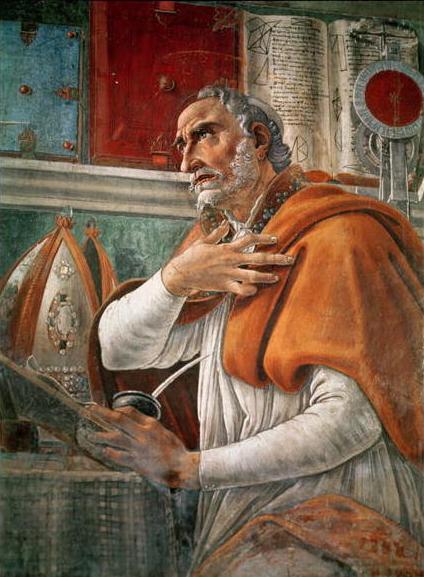
Faith and Seeking Understanding

Saint_Augustine_Portrait

Botticelli: St. Augustine

Christian faith is not the conclusion of an argument: it begins in some sense or other in a personal encounter with God. Some people experience this encounter in a dramatic way, for others, it is much gentler and quieter. But we believe because we believe God, who, in some way, speaks to us. This belief is more a matter of personal trust in the God who loves us and has revealed himself to us than it is the conclusion of an intellectual investigation.

We are created in God’s image, and God is love. Our faith is thus best nurtured by experiencing God’s love through prayer, worship, and the sacraments, by acts of service or contemplation that we do out of love for God, and by Christian community, where we love others and experience and are nurtured in love.

God also knows and understands everything, and our desire to understand Him and the world He has created is part of His image in us. Although belief and trust are primarily personal responses to God’s love for us, we also want to understand what we believe and who we trust. There are, moreover, parts of Christian teaching—like the Trinity, the Incarnation, or the virgin birth—that are difficult to understand. And Christian faith also gives rise to difficult questions: for example, if God is all knowing and all powerful, and He desires what is good for everyone, why is there so much evil and suffering in the world?

Continue reading

Why Did Paul Object to the Arsenokoitai?

My own beliefs about Biblical teaching on homosexual acts are relatively simple: the Jewish Law prohibited any sex between two men (Leviticus 18:22, 20:13). Paul renewed that prohibition in the New Testament (1 Corinthians 6:9, 1 Timothy 1:10) and taught that such acts are “contrary to nature” (Romans 1:27). The Church has always regarded homosexual acts as serious sins. Thus, for me, the primary questions are, “How do I obey this teaching?” or “How does this teaching harmonize with the importance of loving and being loved in the Gospel teaching more broadly?”

However, the range of possible controversies behind those relatively simple beliefs is vast. I wrote a little about this in my recent post on Pederasty and Arsenokoitai, and @ladenheart, a friend who knows the classics much better than I do, has written a thoughtful response. His post is rich, well worth reading, and raises too many questions for me to address here. I will make at least a partial response, however. Near the end of his post, he offers the following tentative conclusion:

My general sense – although I do admit, it is a work in progress – is that what the Judeo-Christian tradition is condemning when it speaks negatively of sexual acts between men are, demonstrable in most cases, acts that are based on exploitation, unequal status, or excess.

I agree with him that, if we really want to understand what the Apostle Paul and the subsequent Christian tradition were trying to say, we need to understand the cultural context that he was writing in. However, we also need to understand the mind with which he judged that world. My concern with @ladenheart’s post—and I raise this as a concern needing further discussion, not a conclusion—is that he focuses heavily on the historical details of ancient paganism, but then judges what he finds with largely 21st century eyes.

Continue reading

Pederasty and Arsenokoitai

One argument that is sometimes offered by Christian advocates of same-sex marriage is that the Apostle Paul was not thinking of loving, monogamous adult relationships, and only intended to condemn Greco/Roman pederasty. I’ve been spending a lot of time reading ancient Greek texts on sexuality recently, and that has gotten me thinking in general about Paul’s historical context and, more specifically, about this argument.

First, it’s important to acknowledge that relationships between adult men and adolescent boys or young men were the most commonly attested same-sex relationships in the ancient world. There are exceptions—Plato’s Symposium discusses committed, lifelong same-sex relationships—but this is by far the most common kind of relationship. We should therefore acknowledge that the Apostle Paul was likely most familiar with this kind of same-sex sexual activity.

It’s worth observing, however, that precisely because this form of same-sex sexuality was so common, there was standard terminology in Greek for talking about these relationships—the older man was the erastes (lover) and the younger man the eromenos (beloved). If these relationships were Paul’s target, it would have been reasonable for him to use these standard Greek terms.

Instead, he used an apparently novel term, arsenokoitai, which either he invented or which he took from Helenistic Judaism. The most logical derivation of this new word is from the Septuagint translation of Leviticus 18:22, which says that you shall not lie with (koiten) a man (arsenos) as with a woman.

Continue reading

The Silence of Jesus and the Voice of the Apostles

Late last week Sarah Pulliam Bailey posted an interview with Marilynne Robinson. Here’s an excerpt:

Q: For Christians who hold the view that marriage is between a man and a woman, do you think they’ll become a smaller group over time?

A: It’s hard to know. There has never been a period in world history where same-sex relationships were more routine and normal than in Hellenistic culture at the time of Christ. Does Jesus ever mention the issue? I bet it must have been all around him. You can get in a lot of trouble eating oysters if you are a literalist about Leviticus. I’m a great admirer of the Old Testament. It’s an absolute trove of goodness and richness. But I don’t think we should stone witches. And if you choose to value one or two verses in Leviticus over the enormous, passionate calls for social justice that you find right through the Old Testament, that’s primitive. There are a thousand ways that we would all be doomed for violating the Sabbath and all kinds of other things, if we were literalists.

I revere Marilynne Robinson—if there’s a midnight release party at my local bookstore for her novel Lila this fall, I’ll be there—but her answer here represents so much of what I find distressing about the quality of our debates over these matters at present.

Continue reading

Building Bridges at Pepperdine and Seattle Pacific

On April 13, Justin Lee and I did a joint presentation, Let’s Talk about [Homo]sexuality, at Seattle Pacific University. Like previous presentations at Pepperdine University and Gordon College, we shared a bit about our own stories, offered some practical tips for building bridges in the midst of disagreement. We also each presented a brief overview of our own beliefs about Christian sexual ethics, Justin arguing that Christians should bless same-sex marriage, and me arguing that they should not. Rachel Held Evans recently highlighted this as the “Best Dialogue” on sexual ethics.

Continue reading

Caught in the In-Between: A Reflection on the ERLC’s Panel on Homosexuality

As I was sitting at home on Monday night, I had every intention of watching some playoff hockey and then heading to bed. But a quick glance at my Twitter feed during a commercial break reminded me the ERLC Leadership Summit was happening, and that the panel on homosexuality was about to start. Intrigued, I decided to tune in. I kept my Twitter feed up to see what type of response this panel might receive from the broader internet community.

ERLC Homosexuality Panel

How can I describe what it was like to listen to the panel? As someone who comes from a conservative church background and counts many Southern Baptists as friends, I was both sympathetic and hopeful for the ERLC’s panel discussion. As someone who is deeply invested in LGBT issues and has seen the church fail routinely in this area, I was also nervous. They were, after all, in a sense talking about me.  Continue reading

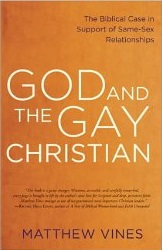
A Review of God and the Gay Christian

God and the Gay Christian - Matthew VinesI got the chance to spend some quality time with Matthew Vines earlier this year at a conference, and it was clear through both our interactions and his writing that Matthew is a sincere man who engages this conversation with grace. Matthew takes Scripture seriously, and he argues for affirmation of same-sex marriage because he truly believes that is the redemptive vision of Scripture and the most loving posture the church can have toward gay people. I want to say from the outset of my review of his book, God and the Gay Christian, that it’s obvious Matthew has been deeply troubled by the way the church has mistreated the gay community, and he feels it can’t reflect God’s heart toward men and women made in His image. I believe he’s correct in that analysis, and while I disagree with his answers to the problem, I believe the church would do well to listen to the concerns he raises because they’re concerns that need to be taken seriously if we’re going to demonstrate love and compassion toward this group of men and women loved by God.

Continue reading

The Freedom Baptism Brings

Describing the new community of the baptized, Paul writes, “There is neither Jew nor Greek, there is neither slave nor free”—and then you’d expect him to follow it up with “there is neither male nor female” (Galatians 3:28). But he doesn’t. He breaks the rhythm of the sentence and writes, “there is no longer male and female” (ouk eni arsen kai thelu). He trades in the “neither/nor” structure and substitutes instead the simple conjunction “and” (kai), which is puzzling.

Numerous readers have noticed that Paul is here alluding to the Greek version of Genesis 1:27, which reads: “God made man; according to the image of God, he made him; male and female he made them.” The implication, then, of Paul’s words would seem to be that there is something about the structure of creation itself that is now being altered or reconfigured by the work of Christ. As the great biblical scholar J. Louis Martyn has put it, there seems to be in view here a “new creation in which the building blocks of the old creation are said to be nonexistent.”

Continue reading

“S1NGLE – God’s Gifts : Our Plan”

Here’s something that may interest some of you.

On Saturday I spoke at a conference on singleness at Redeemer Presbyterian Church in New York, and the videos are all online if you want to watch them. My session starts (I’ve been told, I think!) around the 40-minute mark in the video labeled “Morning Sessions,” and I was also on a panel with the other speakers in the afternoon.

It was a real joy to finally have the chance to visit Redeemer. I’ve been listening to Tim Keller’s preaching since I was in high school, so it was a huge honor to meet him and Kathy and Brent Bounds the other amazing conference organizers. If any of you are reading this, thank you again for the warm hospitality and the stimulating conversation!

A Church of Pure Imagination

I’ve been asked multiple times in the past month why I am still side-B, why I am still pursuing celibacy as a gay 23 year-old in these United States of America. What is interesting to me is how, with each inquiring friend, it was implied that we weren’t discussing theology or the interpretation of certain notorious texts. The “why” was really more of a “how.”

It’s a refreshing change.

One of the more frustrating things about the current conversation is how it so easily gets sucked into the myopic quicksand of “what the Bible says.” Please don’t get me wrong, I’m a big fan of the authority of scripture and the importance of right interpretation, and I probably wouldn’t be celibate if I didn’t think the Bible taught it, but there is a dangerous attitude of “the Bible says it, I believe it, and that settles it” running rampant in many churches.

The idea that the conversation straight up ends with interpretation is, honestly, lethal to true religion, strangling the imagination out of faith and poisoning the endlessly complex “how then shall we live” of the Christian life. I think the rate at which gay Christians are abandoning celibacy is a pretty good indicator of that fact; though not always the case, the majority of people I know who have made the switch do so notbecause they’ve been convinced by “affirming” theology but because celibacy and an abundant life seem mutually exclusive, which, I need to add, is a kind of theological reason in its own right.

Continue reading