
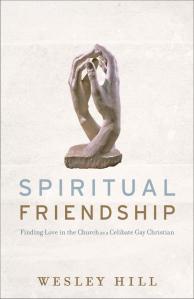
Here’s something I wish I’d seen when I was doing research for my friendship book—a wonderfully pastoral essay by scholar Timothy Lim Teck Ngern on how to live out Aelred’s vision of spiritual friendship in contemporary Western cultures.
Consider this very human paragraph:
Why does friendship hurt? Life is messy, and sometimes, even with preventive measures (such as setting good boundaries and demonstrating mutual reverence), heartaches still knock at our doors. The reciprocity of love as the fountain and source of friendship would imply that if a friendship hurts, it is often due to differing degrees of reciprocity between friends. It is like the case of Jerome’s disappointment with Heliodorus or William of St. Therry’s question to Bernard of Clairvaux that “you did not love me as I did you” (note: not to be interpreted with any sexual overtones). To a large extent, the degrees of reciprocity depend on the nature of the friendship in Aelred’s conception, whether it is carnal, worldly, or spiritual. In essence, friendship hurts because friends disappoint us, regardless of their intentionality, and because we live in a world characterized by jealousy, possessiveness, and selfishness.
I tried to write about these sort of heartaches in my book, and I hope to say more about that in another post soon, in dialogue with some thoughts from my friend Tim Otto.
And yet—
Aelred embraces a biblical notion that a friend loves at all times, even when friends falter; it would suggest that forgiveness is possible. On the limits of friendship in Book II, he acknowledges that those who previously followed wayward paths of lusts and avarices may return to fellowship if they are learned to control over their inordinate affections and behaviors. He further postulates that if Christ forgives us and asks us to love our enemies like friends, then, there can be forgiveness however difficult it may be. Some may read Aelred’s comment on distancing from the wayward as an act of judging others. However, the Aelredian paradigm is not an act of casting aspersion, but that of inner discernment, so as to admit into closer friendship with those who show signs of desiring a godly life.
If I wanted to give someone a quick digest of the wisdom of Aelred of Rievaulx on friendship, I’d probably point them now to this gently instructive essay.


 We often speak of love at first sight, and, since Freud, are invited to think of it primarily in terms of sexual attraction. But I suspect that the phenomenon of being suddenly drawn to someone—but drawn to them as a potential friend, not as a potential lover—is much more common than we usually think. In Surprised by Joy: The Shape of My Early Life, Lewis himself related an experience like this from his own boyhood:
 Spiritual Friendship
You must be logged in to post a comment.