Reading Sarah Coakley

One of the most significant books I’ve read recently (or just anytime, period) that has to do with gay Christian whatnot is Sarah Coakley’s new God, Sexuality, and the Self: An Essay ‘On the Trinity’. You can read a very short version of some of its main lines of argument here, and, if you’re interested, you can read my take on the book over at First Things for low price of $1.99 (or why not subscribe?)!

Joshua Gonnerman has already mentioned Coakley’s project here at SF, but I wanted to mention it one more time and draw your attention to a new review of it from Beth Felker Jones. I mention this because I think Felker Jones’ critique of Coakley’s book is especially relevant for the conversations we’re having here at SF.

Continue reading

“His Grief Became a Light to Us”

A reader of my book Washed and Waiting, in which I talk at some length about Henri Nouwen’s life as a celibate gay priest, just wrote me an email about how that part of Nouwen’s life intersected with his own. With my reader’s permission, I’d like to share a portion of his email:

I was his student at Yale, working on my Ph.D. when I talked someone into letting his masters level, divinity school lecture course count as a Ph.D. class. I was unable to profit much from the course due to my biases and the form my brokenness took at the time, but I did get into one conversation with him about [John] Calvin’s spirituality after a class. My profs that year featured one luminary after another—Luke Johnson, Sidney Ahlstrom, Conrad Russell (son of Bertrand), etc.—so I wasn’t awestruck, but as he invited me to walk back to his office, then to stay a while, I felt that I never so completely had the attention of someone who didn’t know me at all. He listened with a stunning focus—as if I were the only person in his world, that nothing could be more important than my shallow comments and questions. At the end, he encouraged me a little and gave me a copy of one of his books, with a lovely inscription. No one knew of his same-sex attraction, but some of us felt that he suffered from some wound that, coupled with his holiness and insight, expressed itself in his marvelous tenderness. So his grief, handled with maturity, became a light to us—a model for us all.

I was greatly moved by this remembrance, and I share it here as a reminder of what grace our gay Christian lives are capable of. Even in the midst of longing and yearning like Nouwen’s, we are given gifts that we may pass on to others.

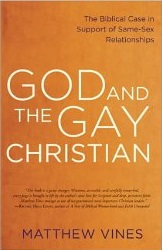
A Review of God and the Gay Christian

God and the Gay Christian - Matthew VinesI got the chance to spend some quality time with Matthew Vines earlier this year at a conference, and it was clear through both our interactions and his writing that Matthew is a sincere man who engages this conversation with grace. Matthew takes Scripture seriously, and he argues for affirmation of same-sex marriage because he truly believes that is the redemptive vision of Scripture and the most loving posture the church can have toward gay people. I want to say from the outset of my review of his book, God and the Gay Christian, that it’s obvious Matthew has been deeply troubled by the way the church has mistreated the gay community, and he feels it can’t reflect God’s heart toward men and women made in His image. I believe he’s correct in that analysis, and while I disagree with his answers to the problem, I believe the church would do well to listen to the concerns he raises because they’re concerns that need to be taken seriously if we’re going to demonstrate love and compassion toward this group of men and women loved by God.

Continue reading

A Frustrated Reader’s Report

I’ve been reading a few recent essays on sexual ethics written for a popular audience. A couple of them have focused specifically on homosexuality, and each one draws a strikingly similar contrast. On the one hand, these essays describe a kind of Christian faith that is focused on “certainty,” on “black and white answers,” on “knowing what’s right,” and the arrogant rigidity and coldness that goes along with that. On the other hand, these essays talk about a different sort of Christian faith, one that is more interested in “exploration,” in “questions,” in “living with tension,” in “loving real people where they’re at,” in being willing to brave the “messiness” of “life in the trenches.” (All the quotes here are paraphrases because I’m not trying to single out one author or essay or book for critique. I’m more interested in observing a trend in the reading I’ve been doing.)

In response, I find myself wanting to ask, over and over again:

  • Is it possible that the “certainty” that pre-marital sex is a bad idea is itself the result of profound “exploration,” of “living in tension,” or “loving real people”?
  • Is it possible that the “black and white answer” of marriage being a covenant between one man and one woman is an answer that’s been forged as Christians have “wrestled” with the “messiness” of “real life”?
  • Is it possible that the “rigid, arrogant knowledge” that divorce is something Christians ought to work hard to prevent is the result of a profound “struggle” to “meet people where they’re at”?
  • Can we at least entertain the idea, for the sake of argument, that the Christian tradition’s “answers” on sexual ethics aren’t just the product of unexamined patriarchal assumptions and power moves on the part of greedy bishops and priests?
  • Can we at least consider the idea that the tradition might have been crafted, in part, from a hard-won, long-sought-after, humane wisdom that knew things about humanity and sexuality that we, in our time, may have forgotten?

Continue reading

Understanding Sexual Identity

Growing up gay in conservative churches, I felt torn between two worlds and bounced like a ping-pong ball back and forth. One moment I was sitting in church hearing, “Homosexuality is the most disgusting sin in the world” (internalizing it as: “Who you are as a person, Julie Rodgers, is toxic and unlovable”). And the next moment I was in a gay coach’s office hearing, “God made you gay, Julie, and you’ll feel forever tortured until you depart from the faith you grew up with and celebrate the entirety of what it means to be a lesbian in our family.” Something deep inside of me resonated with both communities, but both communities usually insisted I cut off, hide, or deny an integral part of who I was in order to fully belong. I felt like there were conditions upon their acceptance of who I was as a person, and qualifications around “I love you” statements. All I wanted during all those years was for someone to walk with me where I was. I wanted someone to see me, to listen to me, to have some compassion, to get outside the culture war long enough to realize I was a complex person in the process of figuring out what it meant to be gay-as-all-get-out and love Jesus with all my heart.

Continue reading