More On Coming Out Part 2: How Open Should You Be?

As I mentioned in my last post, I’m often asked by other sexual minority Christians how open they should be about their sexuality. There is no single answer for everyone, so I would like to offer some reflections on the process of discernment. Towards that end, in my previous post I discussed my own story of getting to where I am today. In this post I will offer my advice for others, using the second person for convenience.

Rainier Waterfall Crossing

One thing I want to point out from the beginning is that there are very few cases where I’d say you are actually obligated to discuss your sexuality. About the only case I can think of is that your spouse or even potential spouse, if you have one, needs to know as early as possible. Otherwise, it’s ultimately your own decision how widely you want to open up. As I’ve discussed before, I think you really ought to open up to a few people for your own good, but it’s your decision how broadly to do that.

For my straight readers, I should offer the aside that it’s really important to respect a sexual minority person’s choices about who to come out to. If someone has trusted you with a secret about their sexuality, you need to keep it secret. If you think he or she would do well to open up to a particular person or group, you can encourage him or her to do so, but never do the sharing yourself without permission.

Continue reading

More On Coming Out Part 1: How I Got Here

Back in 2013, I wrote a post about the importance of “coming out” and how I first started coming out to people. (In that post, as well as this one, by “coming out” I simply mean disclosing my orientation.) I previously focused on the initial process of coming out to a few friends and/or family members for support. As should be obvious from the fact I’m blogging here under my real name, that was only the beginning of a trajectory towards becoming much more open.

Given what I’ve been doing, I’ve found that a lot of sexual minority Christians have been asking me about how open they should be about their sexuality. I don’t think there is a one-size-fits-all answer to that question. Rather, it’s a process of discernment that depends on individual circumstances.

I’d like to offer some reflections on that process. In the past, people have found it helpful when I’ve put my practical reflections in the context of my own experience, so in this post I will offer a summary of how I got to where I am today.

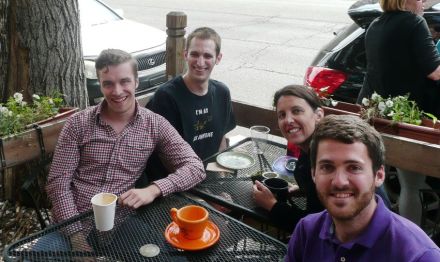
Steve, Jeremy, Karen, and Brent

I blame these folks.

.

When I initially started coming out to people, it was about pursuing emotional health and, to a significant degree, change in orientation. Although I never found the orientation change I was looking for, I did come to a place of peace. I had enough people in my life who knew about my sexuality to feel that I was being known, and I wasn’t so overwhelmed by shame. I didn’t really see the need to open up more broadly, though I did know that as I moved to new places for graduate school and employment I would need to develop new support networks.

Continue reading

To Celibacy—Part 1

Editor’s Note: When the founders and regular writers at Spiritual Friendship originally got together, we united around the following statement: “God created us male and female, and His plan for sexual intimacy is only properly fulfilled in the union of husband and wife in marriage.” But we also recognize that there are many folks in the church who are still trying to come to grips with traditional Christian sexual ethics and aren’t as certain as we are of what they embrace. Others are pretty sure that we at SF are wrong, and so they are instead upholding what’s come to be called a “Side A” stance (that God blesses monogamous, faithful same-sex sexual partnerships). Those of us who edit and write regularly at SF haven’t changed our views at all, but we do from time to time want to offer a platform to friendly dissenters.

Tim OttoTim Otto (MTS, Duke Divinity School), the pastor for teaching and preaching at Church of the Sojourners in San Francisco, is someone who identifies as gay, Christian, and “Side A,” but he’s also celibate. And Tim has remarkably insightful things to say about celibacy—things that we believe our readers would want to hear and think about. So, although we and Tim aren’t in complete agreement, we want to share two recent reflections he’s written on his vow of celibacy with which we are in agreement. We want to share these two posts because we believe they’re compassionate, humane, insightful, and worth pondering. We at SF are grateful for Tim Otto’s friendship, and we commend these posts to you for prayerful consideration. If you are interested in more, you may want to check out his book, Oriented to Faith: Transforming the Conflict over Gay Relationships. You can also follow him on Twitter at @Tim_Otto or on Facebook— Wesley Hill

I made a vow, six years ago, to be celibate. The night before the vow I went with friends to a trendy Tapas bar in San Francisco. Next to us a group of frat guys were making loud, boisterous toasts. Their enthusiasm was infectious, and soon we were lifting our glasses with them. At one point my friend, the mischievous Michael, hoisted his glass and bellowed, “To Celibacy!”

CC by Quinn Dombrowski SA -2.0Everyone lifted their glasses and yelled, “Hear, hear!” and then those at the next table began muttering about what they had heard. “What?” “What did he say?” they asked each other.

Now, six years later I find myself asking, “What?” “What have I done?” It is not that I want to renounce the vow. I made the vow thoughtfully; I took the vow knowing it was the next faithful step for me in following Jesus. But as some of my married friends testify, the cost of a promise only becomes evident in the keeping of it.

I’m grieving the sacrifices it entails. I feel guilty about this. My church relates to Christians in South Sudan and as I write this I know that hundreds of thousands of people have been displaced and are living in refugee camps. At its best, knowledge like that helps me keep a sense of perspective on the losses I feel. But I’ve found that if I’m not honest about my perceived losses, I descend into an oppressive, grey cloud. So I will name them and grieve them:

Continue reading

A Blessed Feast of St. Aelred to You

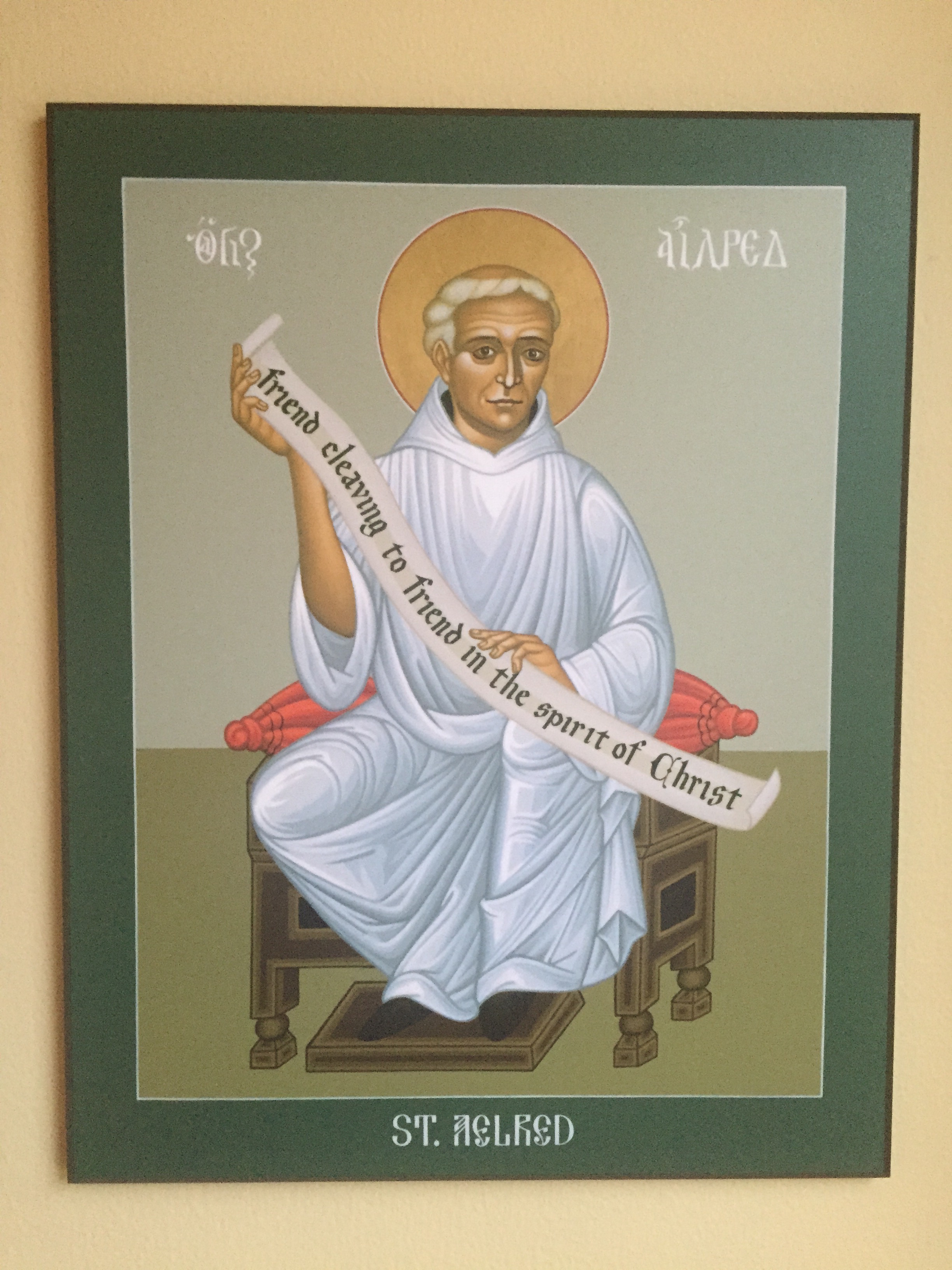
Aelred icon

Today is the feast day of Aelred of Rievaulx, often called the patron saint of friendship. The image above is a photograph of an icon by Br. Robert Lentz, OFM, that some dear friends of mine gave me at Christmas this year.

And here is my memory of visiting the ruin of Rievaulx Abbey a few years ago:

Rounding the bend in the road from the village of Thirsk in North Yorkshire, your first glimpse of Rievaulx Abbey will take your breath away. One minute you’re on a backcountry lane, charmed by the gentle slopes and the green of the farmlands but unprepared for the sudden sight of gray stone walls and arches. The next minute you’re staring at an eleventh-century Cistercian ruin, enclosed in a wooded dale like an unearthed treasure. Coming from the opposite direction, from the east, you might have the reaction my friend described to me once in an e-mail: “I’ve only ever approached Rievaulx on foot, after the over-the-moors-and-through-the-forest walk from Helmsley, but whenever I go there, I imagine those first monks standing in that valley, with the lovely little river running through it and the low wooded hills to break the wind, and saying, ‘Yes. This is the place.’”

My one visit to Rievaulx was a pilgrimage of sorts to honor Aelred, the abbey’s fourth abbot who ruled the Benedictine community from 1147 until his death in 1167. Known best for his treatises On Spiritual Friendship and The Mirror of Charity, in which he sketched a vision for monastic community, Aelred has become the unofficial patron saint of friendship, owing to his powerful depiction of the spiritual fruitfulness of same-sex love. I went to Rievaulx out of gratitude for that witness. I stood in what remains of the abbot’s quarters—now just a stone outline indicating where the four walls would have been—and said a prayer of thanks for the treatises that say of friendship what we moderns typically reserve for marital love: “See to what limits love should reach among friends, namely to a willingness to die for each other.”

I don’t know how you might choose to mark Aelred’s feast day today, or if you’re even comfortable marking saints’ feast days, but I’d encourage you to try something, be it small or large. I myself am planning to make a simple dinner for my housemates to give thanks for their company tonight. Perhaps you would want to start planning an “anniversary of friendship” trip to celebrate the years you’ve known a particular friend, as a friend of mine is planning at the moment for a longtime friend of hers. Or perhaps you’d want to write a note to a friend, expressing your gratitude with words. Maybe you’d want to approach your pastor or priest and ask him or her to come and pray a blessing over you and your friend. Or maybe you’d want to suggest to your priest that there be a Sunday School class or church retreat on the topic, and you could help with the planning and implementation of it. If you’re in college, maybe you’d want to suggest to your campus minister that there be a small group Bible study on the theme; I know one campus minister who’s just written one for her students, and she tells me it’s been a big hit.

Continue reading

Bisexuality and the Spiritual Friendship Conversation

Over a year ago, I wrote a post recounting my experience as a bisexually-attracted man. That post was mostly a reflection on my own experience, with some takeaways coming from that. I’ve been thinking for a while about writing a “part two” discussing how this interfaces with questions of the Christian faith and the broader conversation that Spiritual Friendship is contributing to. I recommend reading my first post before this one if you haven’t already.

Given that I do frequently experience attraction, including sexual desire, towards women, marriage is a significant eventual possibility for my life. Although every marriage has its difficulties, I don’t expect that I’d have significant difficulties resulting specifically from being married to a woman. One could describe me as “celibate” on account of the fact that I’m single and sexually abstinent, but my convictions do not point me toward lifelong celibacy as strongly as for others on here. This state in life may well be much more transient for me. So does this mean that the conversation happening on Spiritual Friendship is less relevant to people like me?

I don’t think so. One thing I’ve really appreciated about how Ron and Wes have run Spiritual Friendship is the way they have intentionally cultivated a conversation that is broader than celibacy. Two of our contributors, Kyle Keating and Melinda Selmys, have written about their experiences in marriages to people of the opposite sex. I’ve learned a lot from them, as well as from other people in similar situations, about what healthy marriages can look like when one spouse is a sexual minority.

There is also a great deal I share in common with celibate gay Christians, simply by virtue of being someone who experiences same-sex attraction and has traditional Christian convictions about sexual ethics.

Continue reading

Does Your Church *Like* Gay People?

On Sunday, while I was in Denver to see my brother and sister-in-law, I visited House for All Sinners and Saints (HFASS), one of the most well known queer-inclusive churches in the country, I suppose. But that reputation wasn’t the only reason why I visited, despite my obvious personal investment in those matters and my intense curiosity on that front. Mostly I chose to visit because I’ve been pretty powerfully affected by Lutheran preaching—with its law/gospel dialectic—and HFASS’ pastor, Nadia Bolz-Weber, is preaching some of the most potent Lutheran sermons around these days. I first heard about HFASS and Nadia from this article by Jason Byassee, I think, and then I read Nadia’s book Pastrix: The Cranky, Beautiful Faith of a Sinner and Saint. Suffice it to say, since then, I’ve been looking for an opportunity to hear this tattooed, foul-mouthed preacher in person, and this last Sunday was my chance.

Now, I disagree with Nadia Bolz-Weber pretty seriously on a whole host of things, many of which I take to be urgently central matters of Christian faith and practice. As a theologically conservative believer who thinks that traditional Christian moral teaching on (say) gay sex can’t be neatly separated from creedal orthodoxy (as if the former were revisable, with the latter able to be preserved intact), I don’t want to offer unqualified praise in this post for what Nadia Bolz-Weber’s ministry is about. Still, though, I find myself agreeing with Rod Dreher that I have something—or more than one thing!—to learn from her about what it means to be a Christian. As I sat there on Sunday night watching her interact with her congregation, and listening to her preach, I found myself wishing that what she models were more characteristic of the conservative churches and communities in which I live and minister. In short, I’m provoked and instructed by her, and I expect to go on learning from her in the coming years.

Continue reading

What’s Next for Love and Marriage?

I published a column in Notre Dame’s Observer today. The Observer has had some debate over marriage in recent weeks, and I thought I would give some thoughts from a gay Catholic perspective:

The first dozen times I came out I cried. For many of my friends, it was the first time they had seen me cry. Ever. A high school friend once told me that I had two emotions: happy, and more happy. She was wrong. I felt a lot of things, but I had to hide them.

Before coming out, many LGBT kids worry that all love is conditional: conditional upon a secret, conditional upon an unmanifested condition, conditional upon being normal. Reading Tyrel London’s viewpoint, “Overcoming Hate” brought back memories of my undergraduate years. Almost no one knew. I suffered. At one point, an evaluator through health services said I may be suffering from major depression, PTSD, social phobia and agoraphobia. The screening urged me to contact a mental health professional. I started looking at graduation requirements at other universities. A semester abroad eventually gave me an escape from Notre Dame without having to answer awkward questions.

The semester away helped me to finally share my secret. Coming out was painful for me. It was painful, not because I was rejected, but because I was accepted. When you spend so much time fearing rejection, acceptance is something that cuts deep into you. It hurts to be loved in the places you’ve been ashamed of. I found acceptance, and I started to accept myself. But even after receiving acceptance from my friends and family, many questions were unanswered. How do I move forward? What does it mean to be gay and Catholic? How do I love?

Continue reading

The Fruit of Traditional Teaching

Photo by MarkusHagenlocher via Wikimedia CommonsOne of the most common ways to argue against the traditional sexual ethic is to cite all the negative consequences that are said to flow directly from it. For example, people point to the high rates of depression and suicide among sexual minorities who grow up within conservative religious communities, and they also remind us that even those who don’t face the most severe mental health consequences still often deal with isolation, fear, shame, and stigma.

The basic argument is this: if we are to judge teachings by their fruit, then we can judge the traditional view of sexual ethics as wrong and immoral.

A common knee-jerk reaction I see from some conservatives is a denial of the problems. I’ve heard several people argue that these claims are just smokescreens for people who want to justify immoral behavior.

I don’t know if I can put this strongly enough: the problems cited are very real, and to deny their existence is to be extraordinarily calloused and unloving. I’ve even experienced some of them, like the fear and shame, myself. And I’ve heard enough stories to know that even the more serious ones like suicidal ideation are shockingly common.

Continue reading

Can the Gay be a Good?

My best friend and I found ourselves in the middle of a crowd of artsy lezzies with our communal gaze fixed on one of our favorite musicians. There was nothing particularly gay going on, but something in the female folk singer happened to draw a certain crowd and that crowd happened to be a bunch of lesbians. My friend and I were both trying hard to be something other-than-gay at that point in our lives, but that night in that venue we felt a freedom we rarely felt: the freedom to stand at ease and release the tension in our shoulders because for one night we could cease to play the straight part and still belong.

We were surrounded by women who knew a slice of our experience: feeling giddy with delight around middle school girls instead of boys, sensing a need to keep it secret if we hoped to be accepted, praying to God to take it away because we wanted so badly to be good, and apologizing for our existence without knowing what we’d done wrong. There was an unspoken solidarity in that space. Just as I was settling into the peace of knowing I was surrounded by others who shared my way of being in the world, I was flooded with a sense of shame. I felt so GAY. The concert brought out my inner lesbian. I wasn’t doing anything wrong, but I felt guilty because I felt so at home.

As I prayed, studied, listened, and introverted in the months that followed, I began to acknowledge that what I was experiencing that night was something I had experienced (and tried to suppress) throughout my entire life: a sense of peace and belonging when I was around others whose relationship to the world was the same kind of different as mine. We were gay. We had been different for as long as we could remember, and regardless of where it came from or how we would choose to express it in the future, it seemed obvious that the self-flagellation we felt the need to indulge in simply because we felt safe and secure in a group of lesbians was not the path to flourishing.

Continue reading

4 Elements of a “Mature Adjustment to Celibacy”

I recently came across the work of Richard Sipe, a former Catholic priest who released an extensive longitudinal study of the sexual practices of Catholic clergy in 1990. Though the book largely focuses on failures to live out celibacy, Sipe points out what he found to be four essential elements of a “mature adjustment to celibacy”:

  • Productive work;
  • A well-defined prayer life;
  • A deep sense of community;
  • And a dedication to service.

Continue reading