World Meeting of Families Transcript

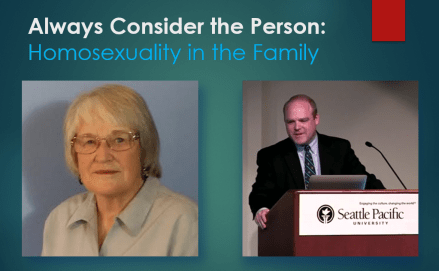
This is a transcript of my presentation with my mother, Beverley Belgau, at the World Meeting of Families in Philadelphia, in conjunction with Pope Francis’s first pastoral visit to the United States. The World Meeting of Families is a global Catholic event, like World Youth Day. The first World Meeting of Families was called together by Pope St. John Paul II in 1994 to celebrate the International Year of the Family. It has grown into the largest gathering of families in the world, and this year’s meeting in Philadelphia beat all previous attendance records.

This was also the first time in the history of the World Meeting that an openly gay—and celibate—Catholic was invited to speak about his experiences in the Church and in his family. 

Because of a room scheduling snafu, we started late (the room was filled to overflowing and hundreds of people were reportedly turned away). To make up, we cut some material on the fly. This reflects the original transcript, not the presentation as delivered. Because this talk highlights a lot of points we have made at Spiritual Friendship over the years, I’ve included links to other posts, if you want to learn more. 

After the formal presentation, we answered audience questions for over two hours; even then, we only left because the Convention Center staff said we had to leave; there were still dozens of people in the room listening, and people in line waiting to ask questions. This speaks to just how important it is for the Church to take more time to talk about how families and parishes can respond to their lesbian and gay members with Christ-like love.

Given the length of the presentation, I have added numbered paragraphs to help locate material within the text.  
Continue reading

Deacon Jim Russell and the Hermeneutic of Suspicion

Update (9/18/2015): In his reply to this post (see his comment below), Deacon Russell says, “we can meet any time, face to face, to charitably address and correct things. I’d be all for that.”

He goes on to say, “As it is, now and forever, here is my challenge to you, Ron. We are engaged in public discourse. In that framework, I will gladly defend all my assertions and positions of the last three years in a direct exchange with you. I will do so charitably and fairly in any number of formats, including live and in person, publicly or privately. This offer will not expire. God bless.”

On July 1, 2015, I invited Deacon Russell to meet face to face with Saint Louis Auxiliary Bishop Edward Rice mediating our conversation. He did not accept. My offer still stands.

Original Post: I rarely respond directly to Deacon Jim Russell; I generally find that there is so much “spin” in his posts that it is difficult to find a productive point of engagement. I usually have responded indirectly, trying to present Church teaching in a positive way that I hope clarifies some of the misunderstandings about Spiritual Friendship that I see in his writings. A couple of points he makes in a recent article, however, may deserve direct clarification (especially in light of the timing of his post and the amount of media attention focused on me because of the World Meeting of Families).

Dome of St. Peter's

The gist of my response is simple: despite Deacon Russell’s efforts at spin, there is nothing contrary to the Catholic faith in ideas like, “obsessing over sexual temptation is unhelpful,” “service to others is helpful in overcoming temptation,” and “friendship is an important avenue of support and intimacy” for those seeking to live a chaste life. But since these straightforward claims have sparked Deacon Russell’s critique, I am taking the time to respond to his criticism at length.

Continue reading

What is the Relationship between Experience and Revelation?

There’s been some recent discussion on Catholic blogs about the relevance of personal experience in conversations about how the Church can provide community and pastoral care to gay and lesbian Catholics who are seeking to be faithful to Church teaching. In order to answer this specific question, it’s worth examining the relationship between revelation and experience more generally.

John Paul II

The Theology of the Body is a collection of addresses given by Pope John Paul II in the late 1970s and early 1980s and addressed to understanding the body and human sexuality in light of the Gospel. In a footnote to the General Audience of September 26, 1979, he wrote:

When we speak here about the relationship between “experience” and “revelation,” indeed about a surprising convergence between them, we only wish to observe that man, in his present state of existence in the body, experiences many limits, sufferings, passions, weaknesses, and finally death itself, which relates his existence at the same time to another and different state or dimension. When St. Paul speaks about the “redemption of the body,” he speaks with the language of revelation; experience is not, in fact, able to grasp this content or rather reality. At the same time, within this content as a whole, the author of Romans 8:23 takes up everything that is offered to him, to him as much as in some way to every man (independent of his relationship with revelation), through the experience of human existence, which is an existence in the body.

We therefore have the right to speak about the relationship between experience and revelation; in fact, we have the right to raise the issue of their relation to each other, even if many think that a line of total antithesis and radical antinomy passes between them. This line, in their opinion, must certainly be drawn between faith and science, between theology and philosophy. In formulating this point of view, they consider quite abstract concepts rather than the human person as a living subject.

Continue reading

Melinda Selmys: Sadomasochism, Satan and Same-Sex Attraction

Over at Catholic Authenticity, Melinda Selmys has a new post about why there is no one-size-fits-all approach to ministry to same-sex attracted Christians:

Consider the following two men:

The first started to look at heterosexual pornography at a young age, eventually graduating to hiring prostitutes. At some point he realized that if went with male partners he could have more sex, and more extreme sex, for free. He was plunged into what he calls the “gay lifestyle”: he made Nazi porn, almost appeared in a snuff film, and attended Satanic gay orgies. He saw friends get AIDS and die, suffered severe health problems as a result of his sado-masochistic practices, and eventually, after some particularly rough sex that resulted in a near-death experience, he repented and came to Christ.

The second was raised in a hard-line Protestant community, and became aware that he was emotionally and sexually attracted to men sometime in his late teens. He was briefy tempted to reject the Biblical teaching on homosexuality, especially after developing a crush on a male friend, but in prayer he discerned that this was not God’s intention for his life. He converted to the Catholic Church and studied theology with a specialization in natural law. He’s never had sex, has never been in a homosexual relationship, and does not struggle with porn—but he has been the victim of anti-gay bullying and discrimination, including discrimination based on his sexual orientation within a Catholic institution.

These are both real people. I offer their stories in order to highlight one of the crucial difficulties in providing pastoral care to homosexual persons: that two people who are both same-sex attracted converts to Catholicism may have literally almost nothing in common. In this case the only point of commonality – and it’s ultimately a superficial one – is that both have been, in some sense, attracted by the idea of having sexual relations with other men.

Read the whole post.

Matt Jones Podcast at Seminary Dropout

Recently, SF contributor Matt Jones was featured on Shane Blackshear’s podcast Seminary Dropout, which has previously featured (immensely cooler, he thinks) authors and speakers such as NT Wright, Walter Brueggemann, and Christena Cleveland.

matt_001

The podcast begins with some autobiography, then covers a range of topics touching on faith, sexuality, and how the ‘culture war’ mentality has deeply harmed the church’s community life and pastoral witness.

Check it out!

A Letter To Myself, On the Night of My Suicide

Garrett ThomasGarrett Thomas is from the Heartland and went to college in the Deep South. He is Southern Baptist and enjoys discussing friendship, family, and ethics from a conservative evangelical perspective. Follow his blog: The Night Is Nearly Over / The Day Is Almost Here. Follow him on Twitter @AlexiusIV.
Note to Readers: This came from quite a dark time in my life. But even in the dark, God works, and He is good, so good. May we never assume that everyone is always doing okay. Let’s ask one another and get in each other’s lives. The church needs to be a place of vulnerability and of honesty, where people are directed toward the hope of the Gospel of Jesus Christ. Because, no one should ever die by their own hand.

“If I take the wings of the morning and dwell in the uttermost parts of the sea, even there your hand shall lead me, and your right hand shall hold me. If I say, ‘Surely the darkness shall cover me, and the light about me be night,’ even the darkness is not dark to you; the night is bright as the day, for darkness is as light with you.” (Psalm 139:8-12 ESV)

Dear Self,

I’m writing this letter to you. Yes, you. You there, laying on your bed, distraught, lonely, and weary. This is coming from you, your future self. As you can imagine, if you’re receiving a letter from me, your plan didn’t work out like you thought it was going to.

It’s dark out, somewhere around 2AM. The stars are out tonight without a cloud to be seen. The moon is giving her pale glow. Everyone has gone to bed, wanting nothing more than to have a long night’s sleep. They don’t know what you’re thinking about right now; they don’t know what’s swirling through your mind. But I do. I know what you’re thinking; after all, I am you. Right now, as it’s been for so long, you’re weary.

You’re about 18, but you feel as if you’ve lived an entire lifetime’s worth of stress, disappointment, and sadness. You feel as if you’ve let everyone in your life down, even though you don’t know why. You feel as though you’ve always been the black sheep. You feel as if you’re all alone in this tough world with no one to talk to and no one who would listen. Your struggles are so deep, and you feel your brokenness so intently that you don’t even have the faintest idea that anyone might actually care for, or about you. You’ve convinced yourself that if the people in your life were to wake up tomorrow, that no one would miss you. That no one would grieve, or at least not for very long. They’d get over it quickly and move on, showing that you just weren’t that big of a deal to anyone.

Continue reading

Clarification on Our Mixed Orientation Marriage

Back in January, I wrote a post about my mixed-orientation marriage with Anna. Since then, I’ve mulled over things I wish I’d said a little better, and things I would have liked to include but didn’t.

The reactions to the post were varied. Many people in our lives voiced their support and gratitude that we’re sharing our journey with them. Others were confused and, quite frankly, turned off by it all. Some saw it as a situation to be fixed, a broken “half-marriage” if you will. Those who do life with us day to day, and those who know us well, are fully aware that this isn’t the case. But with the limited picture painted for them in a few thousand words, I can understand how many see a much more dire circumstance than what actually is.

The fact of the matter is that it is impossible, in the scope of a blog post, to capture all that a marital (or any significant) relationship is. And just as it is important to consider authorial intent when reading divinely inspired scripture, so too must a reader consider the purpose of any writer when making inferences and forming impressions and opinions based on that writer’s words. In fact, I imagine that if we all, myself included, got a little better at that, we’d get a lot further in dialogue with those whose beliefs and experiences run so counter to our own.

Continue reading

C. S. Lewis on Friendship at First Sight

I have visiting nieces and nephews at the moment, which means I’ve been reading more children’s literature recently. As I was reading, I was struck by this passage in C. S. Lewis’s The Voyage of the Dawn Treader:

All morning on the following day they sailed in fairly shallow water and the bottom was weedy. Just before midday Lucy saw a large shoal of fishes grazing on the weed. They were all eating steadily and all moving in the same direction. “Just like a flock of sheep,” thought Lucy. Suddenly she saw a little Sea Girl of about her own age in the middle of them—a quiet, lonely-looking girl with a sort of crook in her hand. Lucy felt sure that this girl must be a shepherdess—or perhaps a fish-herdess—and that the shoal was really a flock at pasture. Both the fishes and the girl were quite close to the surface. And just as the girl, gliding in the shallow water, and Lucy, leaning over the bulwark, came opposite to one another, the girl looked up and stared straight into Lucy’s face. Neither could speak to the other and in a moment the Sea Girl dropped astern. But Lucy will never forget her face. It did not look frightened or angry like those of the other Sea People. Lucy had liked that girl and she felt certain the girl had liked her. In that one moment they had somehow become friends. There does not seem to be much chance of their meeting again in that world or any other. But if ever they do they will rush together with their hands held out.

Lewis GreevesWe often speak of love at first sight, and, since Freud, are invited to think of it primarily in terms of sexual attraction. But I suspect that the phenomenon of being suddenly drawn to someone—but drawn to them as a potential friend, not as a potential lover—is much more common than we usually think. In Surprised by Joy: The Shape of My Early Life, Lewis himself related an experience like this from his own boyhood:
Many chapters ago I mentioned a boy who lived near us and who had tried, quite unsuccessfully, to make friends with my brother and myself. His name was Arthur and he was my brother’s exact contemporary; he and I had been at Campbell together though we never met. I think it was shortly before the beginning of my last term at Wyvern that I received a message saying that Arthur was in bed, convalescent, and would welcome a visit. I can’t remember what led me to accept this invitation, but for some reason I did.

I found Arthur sitting up in bed. On the table beside him lay a copy of Myths of the Norsemen.

“Do you like that?” said I.

“Do you like that?”said he.

Next moment the book was in our hands, our heads were bent close together, we were pointing, quoting, talking—soon almost shouting—discovering in a torrent of questions that we liked not only the same thing, but the same parts of it and in the same way; that both knew the stab of Joy and that, for both, the arrow was shot from the North. Many thousands of people have had the experience of finding the first friend, and it is none the less a wonder; as great a wonder (pace the novelists) as first love, or even a greater. I had been so far from thinking such a friend possible that I had never even longed for one; no more than I longed to be King of England. If I had found that Arthur had independently built up an exact replica of the Boxonian world I should not really have been much more surprised. Nothing, I suspect, is more astonishing in any man’s life than the discovery that there do exist people very, very like himself.

Continue reading

Remembering Dietrich Bonhoeffer’s Martyrdom

[NOTE: Recycling this 4-year-old post in memory of Dietrich Bonhoeffer, who died April 9, 1945.]

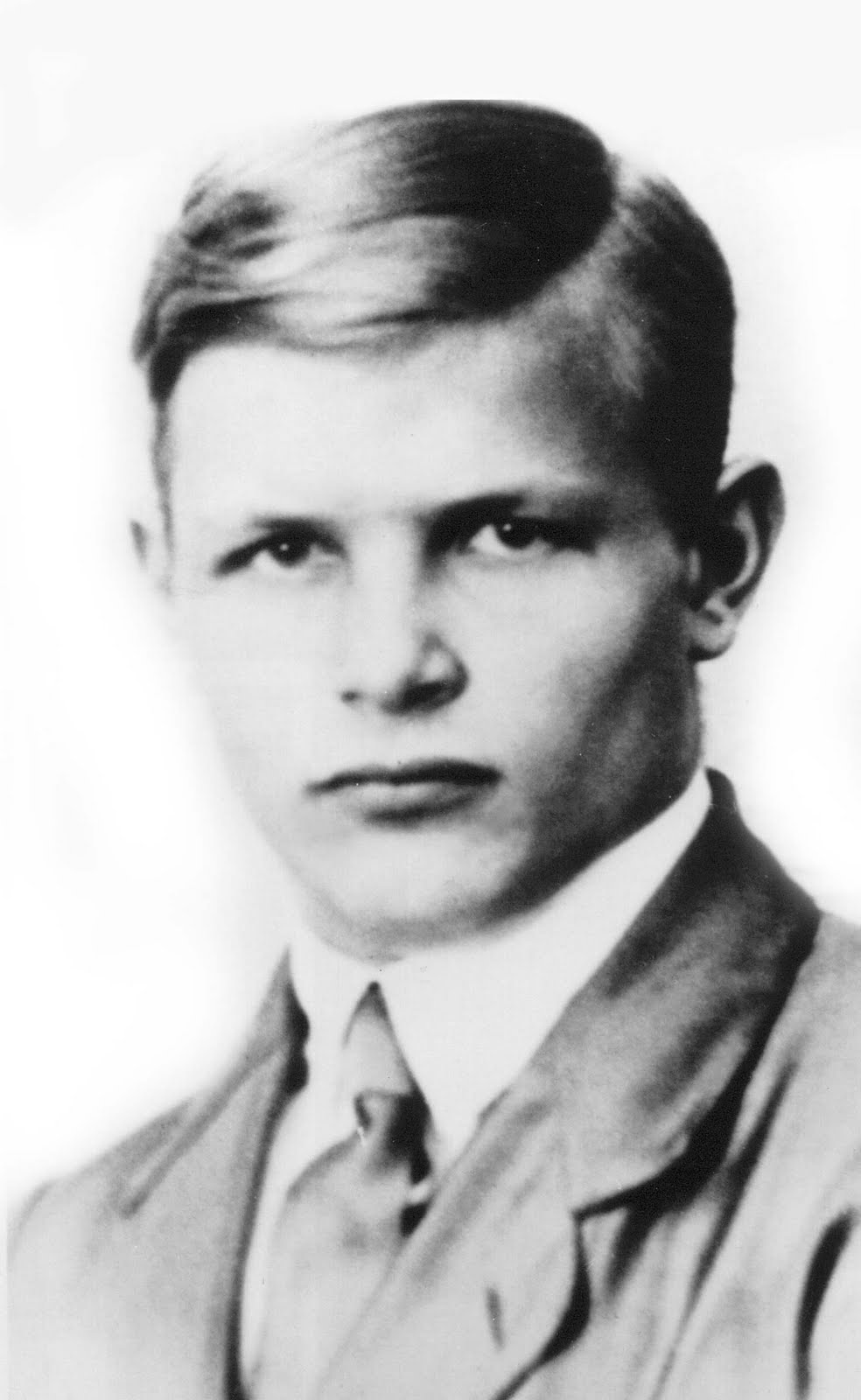
Seventy years ago today, the Lutheran pastor and theologian Dietrich Bonhoeffer was executed by the Nazis in the Flossenbürg concentration camp.

Dietrich Bonhoeffer in 1923

Dietrich Bonhoeffer in 1923

There are two distinctly different accounts of his death. Hermann Fischer-Hüllstrung, a Nazi doctor who witnessed Bonhoeffer’s death, wrote that “I saw Pastor Bonhoeffer… kneeling on the floor praying fervently to God. I was most deeply moved by the way this lovable man prayed, so devout and so certain that God heard his prayer. At the place of execution, he again said a short prayer and then climbed the few steps to the gallows, brave and composed. His death ensued after a few seconds. In the almost fifty years that I worked as a doctor, I have hardly ever seen a man die so entirely submissive to the will of God.”

Dr. Fischer-Hüllstrung may, however, have been whitewashing a much more brutal scene. In Dietrich Bonhoeffer, 1906-1945: Martyr, Thinker, Man of Resistance, Ferdinand Schlingensiepen argues, “Fischer-Hüllstrung had the job of reviving political prisoners after they had been hanged until they were almost dead, in order to prolong the agony of their dying.” Because Bonhoeffer was executed as a political prisoner, he may well have died a lingering, painful death.

Whether Bonhoeffer’s death was a model of peaceful resignation to God’s will, or was drawn out by the horrors of Nazi torture, throughout his life he chose the costly way, repeatedly risking suffering for the sake of fidelity to the Gospel.

In The Cost of Discipleship, Bonhoeffer wrote, “Cheap grace is the preaching of forgiveness without requiring repentance, baptism without church discipline, communion without confession, absolution without personal confession. Cheap grace is grace without discipleship, grace without the cross, grace without Jesus Christ living and incarnate.” On the other hand, “Costly grace,” Bonhoeffer says, “is the treasure hidden in the field; for the sake of it a man will gladly go and sell all that he has. It is the pearl of great price to buy which the merchant will sell all his goods. It is the kingly rule of Christ, for whose sake the man will pluck out the eye which causes him to stumble; it is the call of Jesus Christ for which the disciple leaves his nets and follows Him.”

Continue reading

My Friendship with Ron Belgau

One of the things I’d like to do more often here at Spiritual Friendship is tell stories of friendship. Theological reflection, of the sort I usually do in my posts, can only go so far. What we need more of—what I need more of—are stories of real life friendships that describe how vital Christian friendship can be.

With that in mind, I’d like to pay tribute to my friend Ron Belgau in this post. Ron and I met initially via email, through a mutual friend. When he expressed appreciation for my first book, Washed and Waiting, I asked him to share further thoughts on it. Then, due to how thoughtful and rich his response was, I decided I couldn’t answer it until I had time to produce an equally thoughtful and rich reply—which meant that I stayed silent for about six months. Ron waited patiently, and then he wrote again, and from there our friendship took off. We wrote, we talked via Skype with him in the U.S. and me in England, and, eventually, we had the chance to meet in person at a speaking gig I had and enjoy a long walk along the Battery in Charleston, South Carolina.

Out of those conversations, we started a private online gathering for gay/lesbian/SSA Christians who wanted to try to live by traditional biblical sexual ethics. The conversations we helped nurture there were among the most significant I’ve been a part of. And, eventually, they became the basis for what Ron and I are trying to do here with SF, the sort of public face of our earlier private effort.

Continue reading