
Recently I gave a talk to a group of folks who work for a campus ministry. They had asked me to come and speak on the theme of ministering to LGBT students at colleges and universities. I get a lot of requests like this, and, truth be told, in the days leading up to the event, I was thinking I would simply dust off a talk I’d given a dozen times before. But the more I thought about it, the more I kept combing back through my memories of being a—deeply closeted—college student and of the kind of ministry that meant the most to me. After a few days pondering these memories, I took out a pad of paper and started to write a list. I wrote down the characteristics of the people and the gestures and the conversations that helped me find grace and hope when I most needed it. I came up with a list of ten points, and I’d like to share them here. I’ll post the first five today and the next five tomorrow. And I’d love it if folks added to this list in the comment section.
Uncategorized
Orlando, Obergefell, Christ, and the Church
Over at First Things today, I have some reflections on the sanctuary that was lost in Orlando and the haven Christ offers us all in the church.
Carl Trueman’s Zero-Sum Game

In the wake of the Orlando shooting, RUF campus pastor Sammy Rhodes wrote an apology to the LGBTQ community for various ways that he and other Christians have failed to love them. The various discussion after the shooting exposed to Rhodes some critical ways that Christians, and himself foremost, have failed to love the LGBTQ community. Rhodes had come to the realization that our view of sin must be broader than questions of sexual ethics, as I’ve written about before. I’ve found that many Christians are complacent in these sins in large part due to lack of awareness, and I’ve been complacent in many of them myself for similar reasons. So I was encouraged to see that Rhodes was recognizing them and offering a heartfelt apology to a group of people that was in particular pain. I was especially happy to see this coming from my own denomination, the Presbyterian Church in America (PCA), and from someone in a ministry I’ve been supporting for several years.
The next day, Carl Trueman posted a very critical response. Trueman’s piece was titled “Zero-Sum Game.” As I was reading the piece, his thesis seemed fairly apparent to me. There were two competing perspectives, that of traditional Reformed Christianity and that of the LGBTQ community. Trueman would often pit these against each other as a zero-sum game. For example, when Rhodes apologized for being more concerned about certain social issues than about LGBTQ people, Trueman interpreted this apology as “trivializing the issues of personal and religious liberty which these other cases embody.” I was, however, perplexed to see Trueman then offer the instruction, “do not engage in zero sum games that unnecessarily trivialize other ethical issues and generate false dichotomies.” The deep irony here is that it was not Rhodes who was engaging in a zero-sum game, but rather Trueman. Rhodes apologized for caring more about the issues than the people; he did not apologize for caring about the issues at all.
Orlando
Hey all. I don’t have anything useful to say except to wonder whether your churches and local ministries offered any response to the horrific massacre in Orlando. At Mass yesterday here in DC our priest closed the Prayers of the Faithful by asking us to pray for the victims and their families, for the killer’s family, and for the killer himself, “that love may overcome hate.” His voice stumbled noticeably on that last part for reasons I think we all can understand. Right now we’re trying to work out what our gay & lesbian ministry will do as a memorial. Anyway, I’m interested in what you all have seen so far.
You can donate to a fund for the victims, organized by Equality Florida, here.
Codependency and Ferrante’s My Brilliant Friend
Elena Ferrante’s novel My Brilliant Friend chronicles the lives of two young girls growing up in a poor neighborhood near Naples. The narrator, Elena, describes her relationship with Lila, her headstrong and mysterious best friend, who she both adores and envies. I read this novel with six of my closest friends from grad school, and when we discussed it during our reunion, every one of us had stories about friendships that reminded us of Elena and Lila.
I began searching the book, trying to put my finger on what was so familiar to me, to us, about this friendship. I concluded it had something to do with the way Elena needs Lila in the book.
What does it mean to need one another well? In our hyper-autonomous culture, need is a sensitive word, often associated with the loaded adjective needy. No one wants to be needy; we want to appear confident and able to take care of ourselves. However, the truth is that we are all needy, and we are made this way, and it is good. We are made to need God, and God often meets our needs by using deep, tangible human relationships. Continue reading
Some Possibilities for Narratives of Friendship
I loved Wes’s post on writing about friendship, and figured I’d throw some specific examples out there to see what actual novels and movies suggest about the nature of friendship. These are very much first-draft thoughts, as I hope you guys will riff on them.
[EDITED to add that I should have been much more clear that I’m not presenting the relationships in these works as models or ideals of friendship. Some depict what St Aelred would call “carnal friendships.” Some of them, like The Secret History and especially Let the Right One In, are arguably not about friendships at all, although I would say that these works gain their emotional resonance from the ways in which friendship and cruelty intertwine. If you want a clearer version of my take on LTROI my review is here.]
“The Body” & Stand By Me–friendship as childhood. This heartbreaking Stephen King novella, which was turned into probably the best adaptation of his work for the screen, tells the story of a group of boys who go on a journey to look at a corpse. Friendship is their haven from violence. It’s also their lost idyll. We know from the beginning that they will never again be as close as they were on that summer day long ago. Friendship is a place where you can be known in a way that lovers and spouses–the people you will end up binding yourself to in the adult world–will never know you.
Writing About Friendship
I’m back from the remarkably wonderful Festival of Faith and Writing at Calvin College where I spoke several times on the theme of (what else?) friendship. One of those times was with the retired English literature professor and author Daniel Taylor, and our topic was “Writing on Friendship”—how it’s been done, how we’ve tried it, how it might go wrong, and so on.
That Deathly Silence
There is a fairly famous quote by cartoonist Lynn Johnston that goes, “The most profound statements are often said in silence.” Silence can be a powerful force. Failure to speak can be a form of speaking.
Today is the Day of Silence, a day where many around the country decide to refrain from speaking in order to stand against bullying of LGBT youth. The event originates with the Gay, Lesbian & Straight Education Network (GLSEN). As our cofounder Ron Belgau said in his post on last year’s Day of Silence, “On most questions related to sexuality, we hold positions very different from theirs. It is unlikely that they would endorse our approach, and we do not endorse theirs.” However, despite our disagreements, we do share a common concern for bullying. And days like today present us with wonderful opportunities to speak Christian compassion and love into the cultural issues of our time.

As I was reflecting on the Day of Silence this past week, I began to ponder the different types of silence that often accompany all things LGBT in the Church, and the messages that these silences speak.
Preston Sprinkle: People to Be…Misunderstood: A Response to the Gospel Coalition
Preston Sprinkle has graciously consented to cross-post his response to Anne Paulk here. To check out his other writings, please visit his Patheos blog.
The Gospel Coalition just published a review of my two books, People to Be Loved and Living in a Gray World. The author of the review was Anne Paulk. As a writer, I enjoy good, constructive criticism of my work, and I’m so thankful to have people in my life who give it to me. Since I’m not Jesus, everything I say contains a mixture of truth and error, and I’m on a mission to weed out the latter.
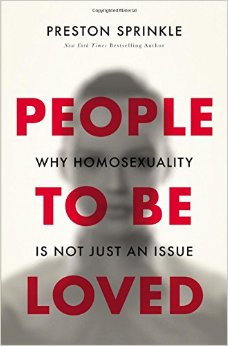 This is why I rarely respond to critical reviews of my books. It could look rather defensive if you do. Plus, who has the time? It’s tough enough to write a book; to respond to its critics would require that I quit my day-job. But it’s difficult not to respond to Paulk’s review. Again, I’m totally fine if someone represents what I say accurately and then disagrees with what I say—preferably by providing evidence. But misrepresenting someone’s work is never helpful especially when people are reading reviews to get an honest idea about the book’s content.
I knew the review wasn’t going to be very accurate when Paulk began by saying that I live in Spokane, WA. I’ve heard that Spokane is a beautiful this time of year. It has lush forests and breathtaking mountain ranges. But don’t take my word for it. This is all hearsay. I’ve never even visited Spokane.
Lessons from the Journey
A few days ago on Twitter, my friend Mollie Hemingway linked to a piece written by a pastor friend of hers, Todd Peperkorn, on depression—or, more specifically, on lessons he’s learned from a decade of surviving depression. I resonated with it very much and found myself almost immediately making connections between Pastor Peperkorn’s experience and my experience of same-sex desire.
Before I go any further, though, I have a caveat or two. I’m wary of Christian portrayals of same-sex attracted folks as “special cases” who are always prone to depression or excessive lust (or whatever). I worry about the power dynamic in play when straight Christians view gay Christians as charity projects. When Christian leaders write sentences like this, “At the heart of the homosexual condition is a deep loneliness, the natural human hunger for mutual love, a search for identity, and a longing for completeness,” I’m not really satisfied unless they turn around and say the same thing about fallen-heterosexuality-as-we-know-it. We’re all prone to weakness, temptation, and sin, and any Christian talk that implies otherwise needs to relearn the gospel.
Furthermore, I think there are crucial differences between the experience of depression and the experience of same-sex sexual desire. The former is something that tends to isolate the sufferer and hinder engagement with others, whereas the latter—misdirected though traditional Christianity understands it to be—is fundamentally about the longing for love, about the desire to give oneself to another human being made in God’s image.
Caveats aside, though, there are genuine connections for me between my same-sex sexual desire and other Christians’ experiences of various forms of suffering. If there is, as Chris Roberts likes to say, “solidarity amongst the many ways of patiently cultivating chastity,” there is also the more fundamental solidarity of sharing in the same fallen condition. Insofar as my sexual orientation directs me away from the kind of sex God intended to be experienced in marriage, I experience it as a “trial.” And in that way, I feel a real kinship with Pastor Peperkorn and his experience of depression. We’re both trying to “work out our salvation with fear and trembling” (Philippians 2:12-13) while contending with what Francis Schaeffer once called our own peculiar mix of the fall.
 Spiritual Friendship
You must be logged in to post a comment.