Noticing the Unnoticed: Some Things I’ve Learned from Being Loved

I’ve toyed with the idea of writing an intellectual autobiography. It would be an imprudently premature work, but, as I’ve turned the idea over in my mind, I’ve come to see the work as an immature inevitability, awaiting only time and much (though inescapably insufficient) work. When I first started to think about this, I considered titling it, “The Men Who Have Loved Me.” I’ve been remarkably lucky to be radically loved by various men in my life: my father, spiritual directors, priests, professors, mentors, roommates, and friends. I’ve been lovingly taught, mentored, cared for, listened to, corrected, and nurtured. I have fond memories of falling in and out of love with friends, with the tenderness of friendship lasting beyond the spark of romance.

But my loves have not only been other men. They’ve also been women, they’ve been other relationships, and they’ve been communities. More than anything, they’ve been the people who have noticed me.

Continue reading

“Just Get Married” and Other Uncaring Advice

When some of my gay friends talk about the struggles of living celibate lives, they are occasionally told by their more progressive friends that they should “just go get married.” I suspect that the speaker believes he is being compassionate, caring, and sympathetic. But he’s not. And neither are the churches who preach this simplistic message to gay Christians seeking to live celibate lives.

For a variety of reasons, many Christians (gay and straight) decide not to marry. Unfortunately, the unmarried life can be very isolating in our culture. Americans have a practice of treating marriage as the only (or at least the primary) means of intimacy and interdependency with significant and lasting obligations.

Continue reading

Building Bridges at Pepperdine and Seattle Pacific

On April 13, Justin Lee and I did a joint presentation, Let’s Talk about [Homo]sexuality, at Seattle Pacific University. Like previous presentations at Pepperdine University and Gordon College, we shared a bit about our own stories, offered some practical tips for building bridges in the midst of disagreement. We also each presented a brief overview of our own beliefs about Christian sexual ethics, Justin arguing that Christians should bless same-sex marriage, and me arguing that they should not. Rachel Held Evans recently highlighted this as the “Best Dialogue” on sexual ethics.

Continue reading

After the Third Way…

… there’s a fourth, and a fifth, and a sixth, and a seventh…

A rather remarkable video has been making the rounds lately. “The Third Way“, produced by Blackstone Films, features the voices of gay Christians who have accepted their sexuality and have sought to live according to traditional Christian teachings. The video navigates between two poles often presented for gay Christians: either repress sexuality for Christianity, or give up Christianity for sexuality. A “third way” is presented, in which the speakers come to love and accept both parts of themselves, seeking to live chaste lives of integration, rather than a fragmented choice.

Continue reading

Misty Irons on Ian Charleson

I watched Chariots of Fire again last night. It’s a powerful film that I’ve loved ever since I first saw it with a friend over 20 years ago. It has had a big influence on my understanding of discipleship and vocation (I discuss this a little near the end of my 2007 GCN Keynote speech). After I finished the movie, I was reading more about it online, and came across this 2011 blog post by Misty Irons, “Thoughts on Ian Charleson“:

I reChariots of Firecently realized that the movie Chariots of Fire, which I watched for about the fifth time last weekend, would have completely failed if it weren’t for the brilliant acting of Ian Charleson who played Eric Liddell. That may seem obvious: Eric Liddell’s character is the inspiration of the movie. He’s the Christian missionary who ran for God’s pleasure, who risked throwing away three years of training and a chance for Olympic gold because he felt he could not run an Olympic heat on the Christian Sabbath. 

People think it’s the story itself that captivates us, but I think it is Charleson’s performance that sells it. His job as an actor was not just to play a good man but a saintly man, pious yet likable, reserved but not dull, conflicted yet steadfast, vulnerable enough to draw our sympathy yet strong enough to stand entirely alone. Then he had to make it look so natural the audience would be tempted to think this guy Ian Charleson must just be playing himself; yet I can’t think of a more difficult acting role. One misstep and the whole thing is ruined: we’re left with a story about a self-righteous prig who’s determined to put the hopes of an entire nation on hold because of his personal fanaticism. The difference between that disaster and the Academy Award winning picture we got is Ian Charleson’s ability to hit exactly the right note.

I got curious about the man who was able to pull off this subtle, multi-layered, highly spiritual performance. I thought, “I really like this Charleson guy. I’ll bet he’s either Christian or gay.” I googled, then wikipedia-ed. Charleson was gay. And reading between the lines he was probably also Christian, judging from how eager he was to play the part of Eric Liddell, saying the role would “fit like a kid glove.” He studied the Bible intensively to prepare for the role and wrote the post-race speech Eric Liddell delivered to the working class crowd himself. Charleson died of AIDS in 1990. He was 40.

Read the rest at More Musings On.

On Gay Jokes, and Friendship versus Presumption

Jokes are one of the first signs of friendship. You have to really know someone to know when the inappropriate may be appropriate, where your nonchalant exclamation of flagrant partial truths will be understood. Jokes about race may be racism or jesting. This is why it’s usually bad form to make jokes about race in public. Only your friends will know the difference.

The same can be said of gay jokes. In general, I’m not a fan of them. But I’ve also come to appreciate them in some ways. I recently made a joke about how I embodied a gay stereotype with some friends, and in many ways, the joke seemed like the opening of a door, the crossing through a threshold. For me to make this joke appropriately, I needed three things: I needed my friends to know me; I needed to be comfortable with myself; and I needed them to be comfortable with me. If any of these are missing, the joke will be misplaced and just awkward. For me to make the joke and for them to understand it as a joke, as a partial truth, is for a friendship to be realized.

Continue reading

The Conversion of St. Augustine

On the liturgical calendar of the Augustinian order, today is the feast of the Conversion of Our Holy Father Augustine. It’s a great time to return to the Confessions, and I have also been working on a (still somewhat rough!) poem to commemorate the feast, and thought I’d share it with our readers. For those who are interested, the Office for the feast can be found here.

Conversion of St. Augustine by Fra Angelico

Tolle, lege. These words begot a soul.
At last the man his sins begins to spurn.
Platonic books can teach, but not make whole,
For still our very hearts to Truth must turn.
Continue reading

Caught in the In-Between: A Reflection on the ERLC’s Panel on Homosexuality

As I was sitting at home on Monday night, I had every intention of watching some playoff hockey and then heading to bed. But a quick glance at my Twitter feed during a commercial break reminded me the ERLC Leadership Summit was happening, and that the panel on homosexuality was about to start. Intrigued, I decided to tune in. I kept my Twitter feed up to see what type of response this panel might receive from the broader internet community.

ERLC Homosexuality Panel

How can I describe what it was like to listen to the panel? As someone who comes from a conservative church background and counts many Southern Baptists as friends, I was both sympathetic and hopeful for the ERLC’s panel discussion. As someone who is deeply invested in LGBT issues and has seen the church fail routinely in this area, I was also nervous. They were, after all, in a sense talking about me.  Continue reading

What Kind of Friend Was Dietrich Bonhoeffer?

My copy of Charles Marsh’s new biography of Dietrich Bonhoeffer will be dispatched to my house soon, so for now I’m making do by reading John Stackhouse’s fine review of it. Someone on Twitter sent it to me the other day, with this tag: “Bonhoeffer was a celibate gay Christian. Thoughts?” Intrigued, I landed on this paragraph from Stackhouse:

Bonhoeffer’s former student, longtime confidante, and first biographer, [Eberhard] Bethge comes through in this book as a significant character—but chiefly as the object of Bonhoeffer’s increasingly lavish affections, the expressions of which in actions, gifts, and words seem to fascinate Marsh perhaps more than they will every reader. Marsh never once refers to homosexuality and only once or twice refers to sexual desire at all, but he frequently paints Bonhoeffer as the ardent suitor while Bethge wants to remain “just friends.” What Marsh doesn’t ever do is explore directly whether a same-sex friendship without sexual desire can be this intense, even erotic in the sense of deep desire for closeness that can become (excessively) possessive. Bonhoeffer, who grew up without a close friend and whose twin Sabine gets married rather young, seems lonely until he meets Bethge, and then pours himself into that friendship as a river surges through a channel rather too small for it. Marsh defends the chastity of the two men, but one wonders if Marsh might usefully have hinted less and ruminated more. (Remember, it isn’t as if Marsh is overdelicate about such themes. He is quite willing to detail and pronounce upon the sexual sins of both Karl Barth and Paul Tillich, and to do so without the scholarly cover of actual citation of sources.)

I can’t tell what Stackhouse intends with the sentence just before the parenthesis. Is he implying that if Marsh had ruminated a bit more, he might have concluded that a pursuit of friendship as intense as Bonhoeffer’s must have been fueled by sexual desire (thus lending credence to the idea that Bonhoeffer was gay, albeit celibate)? Or is Stackhouse rather suggesting that more interrogation on Marsh’s part would have shown our suspicion of Bonhoeffer’s being gay to be a post-gay-rights-era preoccupation, all too ready to classify people as either “gay” or “straight” and not attuned enough to the complexity, even for “straight” people, of desire in simple friendship? As I say, I can’t tell, but I’d like to continue the conversation.

Continue reading

A Review of God and the Gay Christian

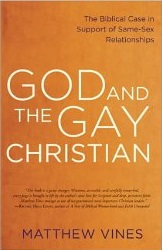
God and the Gay Christian - Matthew VinesI got the chance to spend some quality time with Matthew Vines earlier this year at a conference, and it was clear through both our interactions and his writing that Matthew is a sincere man who engages this conversation with grace. Matthew takes Scripture seriously, and he argues for affirmation of same-sex marriage because he truly believes that is the redemptive vision of Scripture and the most loving posture the church can have toward gay people. I want to say from the outset of my review of his book, God and the Gay Christian, that it’s obvious Matthew has been deeply troubled by the way the church has mistreated the gay community, and he feels it can’t reflect God’s heart toward men and women made in His image. I believe he’s correct in that analysis, and while I disagree with his answers to the problem, I believe the church would do well to listen to the concerns he raises because they’re concerns that need to be taken seriously if we’re going to demonstrate love and compassion toward this group of men and women loved by God.

Continue reading