Sexuality Conversations at Evangelical Colleges

It probably goes without saying that the conversation on faith and sexual orientation is a hot topic at many Christian colleges these days. A growing number of students are talking about their own experiences as sexual minorities, and many people both gay and straight are asking questions about the doctrines they grew up with. Particularly in the evangelical world, I’ve seen some encouraging trends coming from the leadership of some of these colleges, but also some trends that cause me great concern. Campus leaders should not try to hide or suppress conversation about sexual ethics and sexual minorities, but instead should seek to help the campus think through these things openly.
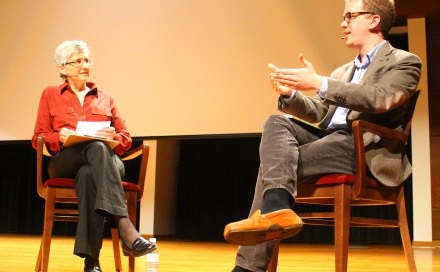
Wesley Hill at Calvin College

At best, some Christian colleges facilitate conversations on sexual identity openly and show that, as one Calvin College staff member put it, “we love our students.” At worst, some colleges try to hide these conversations as much as possible, sometimes to the extent of practicing overt censorship. I will not name individual institutions, but I’m aware of at least two cases in which Christian colleges have exerted power to prevent students from accessing unofficial student publications that include stories of sexual minority students. In those cases, some of the students did advocate for changing Christian teaching, but a primary purpose of the publications was for students to tell their stories. I also know of at least one Christian college at which the administration has prevented the student newspaper from publishing articles about sexual minority students online. I know for a fact that several of those articles did not advocate such a change in teaching. Any of this censorship not only throws sexual minority students, faculty, and staff under the bus, but it actually pushes people away from the traditional sexual ethic.

Continue reading

Scruffy Hospitality

I always like seeing this emphasis in discussions of hospitality:

After seven years of marriage, my wife and I have welcomed numerous friends into our home. Once we decide to host friends for an evening, we usually kick into get ready mode, a fast and furious sprint in the days and hours before our friends arrive. We divide and conquer the to-do list: select a menu, complete grocery shopping, mow the lawn, sweep the floors, run the vacuum, clean the playroom, wipe the bird crap off our lawn chairs (we have lots of trees), set the table, clean the playroom (again), and somehow, someway, pray all that happens before the doorbell rings.

Over the years, that to-do list has prepared us for hosting company, but it has also prevented us from welcoming friends in our home. Unwritten Southern rules of offering hospitality with excellence have affected how often we invite people in our home. ‘We should have the __________s over sometime.’ And then we delay or postpone the invitation. Why? Because the to-do list is always there, the gap between our day-to-day home and the presentable, acceptable-for-hospitality version of our home.

But over the past several months, Emily and I are learning to lay those conventions aside. Why? Because inviting friends into our lives when we are only ‘excellent’ isn’t friendship. Sure, there are still times we like to go all out, spruce up the house and cook a huge, Jamie Oliver style meal. It can be fun and it’s enjoyable to do things well. But that standard of excellence is rarely possible with two children under the age of 3. Friendship isn’t about always being ‘excellent’ with one another. Friendship is about preparing a space for authentic conversation. And sometimes authenticity happens when everything is a bit scruffy.

Continue reading

“Just Get Married” and Other Uncaring Advice

When some of my gay friends talk about the struggles of living celibate lives, they are occasionally told by their more progressive friends that they should “just go get married.” I suspect that the speaker believes he is being compassionate, caring, and sympathetic. But he’s not. And neither are the churches who preach this simplistic message to gay Christians seeking to live celibate lives.

For a variety of reasons, many Christians (gay and straight) decide not to marry. Unfortunately, the unmarried life can be very isolating in our culture. Americans have a practice of treating marriage as the only (or at least the primary) means of intimacy and interdependency with significant and lasting obligations.

Continue reading

On Gay Jokes, and Friendship versus Presumption

Jokes are one of the first signs of friendship. You have to really know someone to know when the inappropriate may be appropriate, where your nonchalant exclamation of flagrant partial truths will be understood. Jokes about race may be racism or jesting. This is why it’s usually bad form to make jokes about race in public. Only your friends will know the difference.

The same can be said of gay jokes. In general, I’m not a fan of them. But I’ve also come to appreciate them in some ways. I recently made a joke about how I embodied a gay stereotype with some friends, and in many ways, the joke seemed like the opening of a door, the crossing through a threshold. For me to make this joke appropriately, I needed three things: I needed my friends to know me; I needed to be comfortable with myself; and I needed them to be comfortable with me. If any of these are missing, the joke will be misplaced and just awkward. For me to make the joke and for them to understand it as a joke, as a partial truth, is for a friendship to be realized.

Continue reading

The Freedom to Love

When many of my friends moved toward a theology that affirms gay sexual relationships, they did so because they grew weary of saying “no” to love. Several of them described an experience where they were fully committed to the church’s traditional teaching on sexual ethics when they grew to deeply love someone of the same sex. They remained chaste for a season and prayed for direction, then eventually sensed the Lord saying: You’re free to love.

While many Christians considered their shift an act of rebellion—a plunge into sin—they saw it as the only path to love and intimacy. They recognized that “It’s not good for man to be alone,” and they longed to serve the one they love, share their lives with the one they love, and mutually draw energy from that love to better serve those around them. Many felt like the traditional ethic required them to cut off fundamental aspects of being human in order to be chaste: they felt saying “no” to sexual relationships meant saying “no” to love, and that saying “no” to love meant saying “no” to any intimacy, and that saying “no” to intimacy meant saying “no” to feelings altogether, which eventually led to detachment and isolation. The burden felt unbearable.

Continue reading

Crucifixion and the Experience of Sexual Minorities

Catholic teaching often speaks of the experience of being gay as a “cross” or “trial”:

The number of men and women who have deep-seated homosexual tendencies is not negligible. This inclination … constitutes for most of them a trial … These persons are called to fulfill God’s will in their lives and, if they are Christians, to unite to the sacrifice of the Lord’s Cross the difficulties they may encounter from their condition (Catechism of the Catholic Church, 2358).

Or, again, in Cardinal Ratzinger’s letter On the Pastoral Care of Homosexual Persons:

What, then, are homosexual persons to do who seek to follow the Lord? Fundamentally, they are called to enact the will of God in their life by joining whatever sufferings and difficulties they experience in virtue of their condition to the sacrifice of the Lord’s Cross. That Cross, for the believer, is a fruitful sacrifice since from that death come life and redemption.

Continue reading

Everyday Intimacy Played Out

I wrote a post earlier this week that highlighted some of my fears for the future related to loneliness. As some of my closest friends have moved away, I’ve caught myself coming home to an empty apartment more often than I’m used to, more often than I would like. People responded with such thoughtful feedback: encouragement, challenges, pertinent questions and words of solidarity.

It seemed fitting to respond to some of the questions in a consolidated manner, and this one opens the door to exploring some related questions about how exactly we might all come alongside one another: “Julie, when you put on your hoodie and stare into space in your apartment, what are you really longing for?”

Continue reading

“The Church is Homophobic”—True or False?

Simone Weil once scribbled down the following “method of investigation,” as she called it: “as soon as one has arrived at any position, try to find in what sense the contrary is true.” Ever since I first read that sentence, I’ve wanted to get it tattooed on my forearm—or at least placarded prominently over my writing desk.

Weil’s “method” explains the appeal to me of my favorite kind of writing—the kind that takes a too-neat, too-tidy narrative and shows how I’ve settled for more simplicity than is warranted. I loved, for instance, this sentence from a book review I read a couple of days ago, LaVonne Neff’s take on Jeanne Murray Walker’s The Geography of Memory: “These are my roots, Walker is saying: … my family’s fundamentalist church, full of answers and rules but also full of love.” As soon as Neff evokes the image of a  “fundamentalist church” that we were expecting, she immediately prevents us from holding onto it in any straightforward way: this was a church full of care and warmth, in spite of the narrowness.

Always saying “it’s complicated” can be a bad thing. But it also helps to guard against hasty generalizations that could prove to be genuinely harmful to people.

Here’s what prompted this.

I was recently reading my friend Sean Doherty’s testimony of his involvement, as a man who experiences same-sex attraction, in various evangelical parishes in the UK. Sean’s story is deeply encouraging, insofar as it includes sentences like this: “At university I said I was gay, and I never experienced homophobic treatment from other Christians…. [L]ove and acceptance was my consistent experience…. I found the church to be a deeply supportive and affirming place. I was nurtured, given responsibility in ministry, and encouraged towards ordination.” That is a wonderful story that needs to be told. And Sean’s main point—that “homophobia” and “traditional Christian belief about marriage and celibacy” aren’t equivalent—is one that needs spelling out, as Sean does: “[L]ove and unconditional acceptance of gay people does not require approval of same-sex sexual activity…. [M]y experience has convinced me that this prejudice and mistreatment does not come from believing what the Bible says about marriage and sex.”

Continue reading

Celibacy and Loneliness

“For both Aristotle and Aquinas, friendship stands at the core of human and Divine reality… If we get that wrong, we get it all wrong.” -Fr. James Schall

When I was a child, I used to have night terrors. When I had bad dreams, I would sit up in my bed and cry or yell while I was sleeping. My parents would have to come up to my room, gently wake me, and then help me fall back to sleep.

I don’t have night terrors anymore, but I do occasionally have bad dreams. Like the night terrors, I don’t always remember them. Once, when I was visiting a friend, he told me one morning that he had woken me up the night before. Apparently, he heard me having a bad dream, so he woke me up, made sure everything was fine, and told me to go back to bed. I don’t remember any of this.

This is one fear I have: suffering under a bad dream in the night and not having anyone around to wake me up, and to tell me to go back to sleep. It sounds silly. It makes me sound like a child. But this is not a childish fear. It’s a human fear. It’s a fear of falling into a brokenness that you don’t even realize and that can only be alleviated by those who have loved you so much that they know you better than you know yourself. It’s the realization that you can become careless or tired and unaware of your failings and that, from time to time, you need people to make up for your inadequacies. It’s the commonly admitted fear of dying alone that acts as a mask for the real, underlying fear: the fear of living alone.

Continue reading

On Coming Out and Being Known

I attended a lecture about disabilities recently. At the end of the lecture, a steady stream of students and professors walked up to a microphone in front of the audience and offered questions to the speakers. The questioners mostly came up one-by-one, asking abstract questions about abstract people. Silence fell when the final questioner stepped before the microphone. It was a woman, her left arm clinging to her friend beside her, and her right arm holding a long white stick extending out in front of her—she was blind. And when the conversation changed from an abstraction discussion about disabled people, to actually talking with a disabled person, there was a subtle but obvious shift in tone.

The moment reminded me of a conversation I had had a few months before. I was around a campfire with a group of Catholic friends, discussing the Church. At a certain point, gay marriage came up. One of the guys, with whom I was friends but didn’t know particularly well, said, “I know that a Catholic guy came out in order to defend traditional marriage when it was being debated, and I understand that. But, as a Catholic, I don’t know why same-sex-attracted people would want to be open about and discussing their sexuality. I mean, I don’t go around discussing my sexuality with other people.”

Continue reading