Holy Saturday for Gay Christians

One of the first Christian books I ever read (once I started reading books on my own, simply for pleasure, in high school) was Philip Yancey’s The Jesus I Never Knew. It ends like this:

The other two days [besides Holy Saturday] have earned names on the church calendar: Good Friday and Easter Sunday. Yet in a real sense we live on Saturday, the day with no name. What the disciples experienced on a small scale—three days, in grief over one man who had died on a cross—we now live through on a cosmic scale. Human history grinds on, between the time of promise and fulfillment. Can we trust that God can make something holy and beautiful and good out of a world that includes Bosnia and Rwanda, and inner-city ghettoes and jammed prisons in the richest nation on earth? It’s Saturday on planet earth; will Sunday ever come?

That dark, Golgothan Friday can only be called Good because of what happened on Easter Sunday, a day which gives a tantalizing clue to the riddle of the universe. Easter opened up a crack in a universe winding down toward entropy and decay, sealing the promise that someday God will enlarge the miracle of Easter to cosmic scale.

It is a good thing to remember that in the cosmic drama, we live out our days on Saturday, the in-between day with no name. I know a woman whose grandmother lies buried under 150-year-old live oak trees in the cemetery of an Episcopal church in rural Louisiana. In accordance with the grandmother’s instructions, only one word is carved on the tombstone: “Waiting.”

Longtime readers of this blog will know that my entire framework for thinking about my life as a gay, celibate believer is built around that idea of “waiting.” In the midst of ongoing loneliness and struggle, I am “wait[ing]… for the redemption of our bodies” (Romans 8:23). And that’s been true for several years now, ever since my early twenties when I was just beginning to work through what my Christian faith meant for my homosexuality.


Continue reading

Will I Be Gay in the Resurrection?

As Lent moves rapidly towards its close, I’ve been trying (and mostly failing) to make space in my life for some more meditative reading, and right now I’m inching through Frances Young’s God’s Presence: A Contemporary Recapitulation of Early Christianity. It’s a remarkably unclassifiable book, as Young weaves her work in Patristics (the study of the church Fathers) together with personal, pastoral reflections, largely revolving around her disabled son Arthur. Today this passage struck me in an especially forceful way:

Arthur’s limited experience, limited above all in ability to process the world external to himself, is a crucial element in who he is, in his real personhood. An ultimate destiny in which he was suddenly ‘perfected’ (whatever that might mean) is inconceivable—for he would no longer be Arthur but some other person. His limited embodied self is what exists, and what will be must be in continuity with that. There will also be discontinuities—the promise of resurrection is the transcendence of our mortal ‘flesh and blood’ state. So there’s hope for transformation of this life’s limitations and vulnerabilities, of someone like Arthur receiving greater gifts while truly remaining himself. Perhaps the transformation to be hoped for is less intellectual or physical advance and more the kind of thing anticipated in the present when the fruits of the Spirit are realized in relationships.

Not only am I intrinsically interested in what Young says here—in disability and resurrection theology—but I also can’t help but be struck by how this relates to my situation as a gay, celibate Christian believer. As readers of this blog know, I (and others) sometimes reach for the metaphor of disability as way of thinking about our sexual orientations. In my book Washed and Waiting I used the metaphor of “healing” to describe how I thought my sexuality would be transformed when Christ returns. In my chapter on Nouwen, I wrote, “I expect to stand with Henri Nouwen at the resurrection and marvel that neither of us is homosexual anymore.”

Continue reading

Prayers for World Meeting of Families and Pope Francis Visit

Ron and Beverley Belgau

This Thursday, my mother, Beverley, and I will give a talk at the World Meeting  of Families in Philadelphia“Always Consider the Person”: Homosexuality in the Family.

What are some ways that Catholic families can respond to a family member’s disclosure that they are same sex attracted, or the announcement that they are gay or lesbian? Ron Belgau, a celibate gay Catholic who embraces and Church teaching, and his mother, Beverley Belgau, will share their own stories as a way of highlighting some of the challenges faced by same sex attracted Catholics and their families. They will also talk about how Catholics should respond with both grace and truth to gay or lesbian friends or family members who struggle with or reject Catholic teaching on chastity.

Continue reading

Thomas Aquinas: Is the Fellowship of Friends Necessary for Happiness?

From Summa Theologiae, Ia-IIae, question 4, article 8:

School of Athens

Objection 1. It would seem that friends are necessary for Happiness. For future Happiness is frequently designated by Scripture under the name of “glory.” But glory consists in man’s good being brought to the notice of many. Therefore the fellowship of friends is necessary for Happiness.

Objection 2. Further, Boethius [Seneca, Ep. 6] says that “there is no delight in possessing any good whatever, without someone to share it with us.” But delight is necessary for Happiness. Therefore fellowship of friends is also necessary.

Objection 3. Further, charity is perfected in Happiness. But charity includes the love of God and of our neighbor. Therefore it seems that fellowship of friends is necessary for Happiness.

On the contrary, It is written (Wisdom 7:11): “All good things came to me together with her,” i.e. with divine wisdom, which consists in contemplating God. Consequently nothing else is necessary for Happiness.

Continue reading

What Does “Disinterested Friendship” Mean?

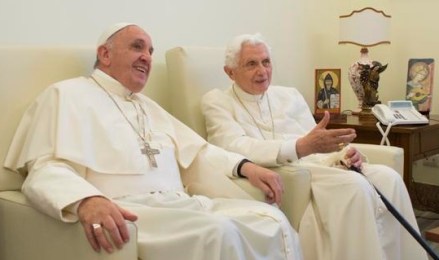
Popes Francis and Benedict

The Catechism of the Catholic Church uses the term “disinterested” in five different places. The most relevant instance for most readers of this blog is:

2359 Homosexual persons are called to chastity. By the virtues of self-mastery that teach them inner freedom, at times by the support of disinterested friendship, by prayer and sacramental grace, they can and should gradually and resolutely approach Christian perfection.

The first definition for “disinterested” at Dictionary.com is “unbiased by personal interest or advantage; not influenced by selfish motives,” which would mean that a “disinterested friendship” is a friendship that is not biased by personal interest or advantage, nor influenced by selfish motives. In the context of 2359, the most obvious selfish motive in view would be lust, though any selfish motive will poison friendship. This unbiased and unselfish friendship seems like the sort of love most of us would want from our friends.

However, the second definition for “disinterested” is “not interested; indifferent.” A usage note points out that

Disinterested and uninterested share a confused and confusing history. Disinterested was originally used to mean “not interested, indifferent”; uninterested in its earliest use meant “impartial.” By various developmental twists, disinterested is now used in both senses. Uninterested is used mainly in the sense “not interested, indifferent.” It is occasionally used to mean “not having a personal or property interest.”

And, this confusion infects many people’s understanding of the term “disinterested friendship” in 2359. To many, “disinterested friendship” suggests a friend who is “not interested, indifferent.” Comparison with other usages of the same word in the Catechism, however, demonstrates that this cannot be the sense the authors of the Catechism had in mind.

2649 Prayer of praise is entirely disinterested and rises to God, lauds him, and gives him glory for his own sake, quite beyond what he has done, but simply because HE IS.

Continue reading

Matt Jones at OnFaith: Avoiding Hypocrisy as the Church

matt_001Spiritual Friendship writer Matt Jones recently contributed to a series on sexuality and the church over at OnFaith, focusing on ways his current church community is modeling a traditional sexual ethic that avoids much of the hypocrisy found in more conservative churches. Some excerpts:

When I joined, I simply became a part of that redemptive movement. This is an enormous blessing, because — believe it or not — I really want to proclaim the gospel through ministry and advocacy. (And, as a white dude brimming with privilege, learning how to do this in a way that doesn’t reinforce inequality can be a challenge!) I want to be a Christian, and I want my church to urge the congregants on in our shared vocation of pursuing justice for the marginalized (which includes a sizable portion of the church population itself).

Often lgbt+ Christians are treated as if we have one job this side of Jesus’ return: don’t have gay sex. But, as Eve Tushnet so quotably stated, “You can’t have a vocation of no,” of only avoiding something. We need something to live for, and let me say that Christianity never makes more sense to me than when I am witnessing or participating in a Christian community that is unified toward imitating and proclaiming Jesus’ liberative gospel.

And:

It continues to amaze me how hard celibate lgbt+ people have to work to find space in churches that claim a more traditional sexual ethic. The social burdens experienced by sexual minorities in these communities vary widely, but usually include increased scrutiny and suspicion, painful comments from congregants who may or may not know about one’s sexuality, reduced ministry possibilities (e.g. I was once stripped of an internship and prevented from helping with a youth group because I wasn’t trying hard enough to be straight), insanely exhausting language policing,**** and at times, the general ache of being single in a culture that over-valorizes marriage and romance to the detriment of thechurch’s calling to be family.

I’m not sure how churches decided that the best ‘defense’ of the traditional sexual ethic is to place excessive burdens on those trying to abide by it and then fail to provide the support structures that would make such an ethic intelligible and healthy . . . but, well, here we are.

I believe the traditional sexual ethic is beautiful and good — I try to live according to it for a reason! — but I also believe that the way churches have approached the topic of human sexuality has largely failed to do any justice to the scope and nuance of the doctrine and has, in fact, done injustice to countless people who should have found a home and family within the church, and this requires sincere repentance.

Read the Whole Article at FaithStreet.

A Pentecost Meditation

This coming Sunday is the Day of Pentecost (for those of us in Western traditions), and it has struck me powerfully in recent years that we don’t really have a name for the time between Ascension Day and Pentecost.

The collect for the Seventh Sunday of Easter from the Book of Common Prayer bridges the gap between those saving events by connecting Jesus’ ascension with the Spirit’s outpouring: “O God, the King of glory, you have exalted your only Son Jesus Christ with great triumph to your kingdom in heaven: Do not leave us comfortless, but send us your Holy Spirit to strengthen us and exalt us to that place where our Saviour Christ has gone before; who lives and reigns with you in the unity of the Holy Spirit, one God, now and forever, Amen.” Still, even in that prayer itself (whose precursor, incidentally, the Venerable Bede is said to have prayed on his deathbed), you can hear how the time between Ascension Day and Pentecost is one of those liminal periods in the church’s year, like Holy Saturday, when we’re reminded of the fact that a basic task of God’s people is simply to wait. Jesus is bodily absent from his followers at this point, having ascended into heaven, and yet the Spirit has not yet been given. “And while staying with them he ordered them not to depart from Jerusalem, but to wait for the promise of the Father…” (Acts 1:4).

Wait.

And the Spirit himself, after he has been poured out on the day of Pentecost, becomes a sign of a different kind of waiting but one that is still, nonetheless, waiting. His presence doesn’t so much “make up” for the absence of Jesus as insure that Jesus and his followers will one day be reunited. The Spirit acts as a kind of engagement ring, a pledge and foretaste of the still-future consummation of the Lamb’s wedding feast. The Spirit, St. Paul says, “is the guarantee of our inheritance until we acquire possession of it” (Ephesians 1:14). So the Spirit, in a sense, enables us to continue living in the liminal space in between Jesus’ first and second comings, an in-between time that was felt acutely after Jesus left and before the Spirit descended in tongues of fire in that upper room in Jerusalem.

Continue reading

A Letter To Myself, On the Night of My Suicide

Garrett ThomasGarrett Thomas is from the Heartland and went to college in the Deep South. He is Southern Baptist and enjoys discussing friendship, family, and ethics from a conservative evangelical perspective. Follow his blog: The Night Is Nearly Over / The Day Is Almost Here. Follow him on Twitter @AlexiusIV.

Note to Readers: This came from quite a dark time in my life. But even in the dark, God works, and He is good, so good. May we never assume that everyone is always doing okay. Let’s ask one another and get in each other’s lives. The church needs to be a place of vulnerability and of honesty, where people are directed toward the hope of the Gospel of Jesus Christ. Because, no one should ever die by their own hand.

“If I take the wings of the morning and dwell in the uttermost parts of the sea, even there your hand shall lead me, and your right hand shall hold me. If I say, ‘Surely the darkness shall cover me, and the light about me be night,’ even the darkness is not dark to you; the night is bright as the day, for darkness is as light with you.” (Psalm 139:8-12 ESV)

Dear Self,

I’m writing this letter to you. Yes, you. You there, laying on your bed, distraught, lonely, and weary. This is coming from you, your future self. As you can imagine, if you’re receiving a letter from me, your plan didn’t work out like you thought it was going to.

It’s dark out, somewhere around 2AM. The stars are out tonight without a cloud to be seen. The moon is giving her pale glow. Everyone has gone to bed, wanting nothing more than to have a long night’s sleep. They don’t know what you’re thinking about right now; they don’t know what’s swirling through your mind. But I do. I know what you’re thinking; after all, I am you. Right now, as it’s been for so long, you’re weary.

You’re about 18, but you feel as if you’ve lived an entire lifetime’s worth of stress, disappointment, and sadness. You feel as if you’ve let everyone in your life down, even though you don’t know why. You feel as though you’ve always been the black sheep. You feel as if you’re all alone in this tough world with no one to talk to and no one who would listen. Your struggles are so deep, and you feel your brokenness so intently that you don’t even have the faintest idea that anyone might actually care for, or about you. You’ve convinced yourself that if the people in your life were to wake up tomorrow, that no one would miss you. That no one would grieve, or at least not for very long. They’d get over it quickly and move on, showing that you just weren’t that big of a deal to anyone.

Continue reading

John Piper on Being Single in Christ

An old (2007) sermon from John Piper: “Single in Christ: A Name Better Than Sons and Daughters.”

I will start and end with my main point and, in the middle, cover a wide terrain of Scripture to support it. My main point is that God promises those of you who remain single in Christ blessings that are better than the blessings of marriage and children, and he calls you to display, by the Christ-exalting devotion of your singleness, the truths about Christ and his kingdom that shine more clearly through singleness than through marriage and childrearing. The truths, namely,

  1. That the family of God grows not by propagation through sexual intercourse, but by regeneration through faith in Christ;
  2. That relationships in Christ are more permanent, and more precious, than relationships in families (and, of course, it is wonderful when relationships in families are also relationships in Christ; but we know that is often not the case);
  3. That marriage is temporary, and finally gives way to the relationship to which it was pointing all along: Christ and the church—the way a picture is no longer needed when you see face to face;
  4. That faithfulness to Christ defines the value of life; all other relationships get their final significance from this. No family relationship is ultimate; relationship to Christ is.

To say the main point more briefly: God promises spectacular blessings to those of you who remain single in Christ, and he gives you an extraordinary calling for your life. To be single in Christ is, therefore, not a falling short of God’s best, but a path of Christ-exalting, covenant-keeping obedience that many are called to walk.

Watch the video above, or check out the whole sermon at Desiring God.

Wartburg Watch: Even Celibacy Is Not Enough for Some Christians

Washed and WaitingOver at a blog called The Wartburg Watch, there’s a nice discussion of Spiritual Friendship and some of the challenges we’ve received from conservative critics. The post (and the blog) may be of interest to some of our readers.

Years ago, when my little daughter was suffering from brain tumor, I felt overwhelmed with the difficulties of managing my other children while coping with my own feelings of overwhelming pain for my daughter and fear for her future. My husband had to maintain his job so that we had the insurance to help pay for the medical bills. I felt quite lonely even though I had wonderful friends who supported me, helping with my other children and making meals for us. How does one explain the pain and fears to others who are not experiencing it?

I was directed to a group that dealt with the difficulties of having a child with a serious brain tumor. I found great comfort in the group as we discussed our issues. Children’s Hospital in Dallas provided professionals to help us work through all sorts of things. It was so comforting to be with a group of people who got it even if I didn’t say a word.

I grew to understand the importance of the support such groups offer. We formed friendships and held each other up through the inevitable pain and sorrows that arose.

That is why I was excited when I learned about the development of Spiritual Friendship amongst celibate gays. Before I go any further, I would ask that we keep this discussion centered around those gay Christians who have decided that they believe they should remain celibate. This is important to this post because I want to show that even when individuals make decisions that should be acceptable to conservative Christian, they still get criticized.

Check out the whole post.