
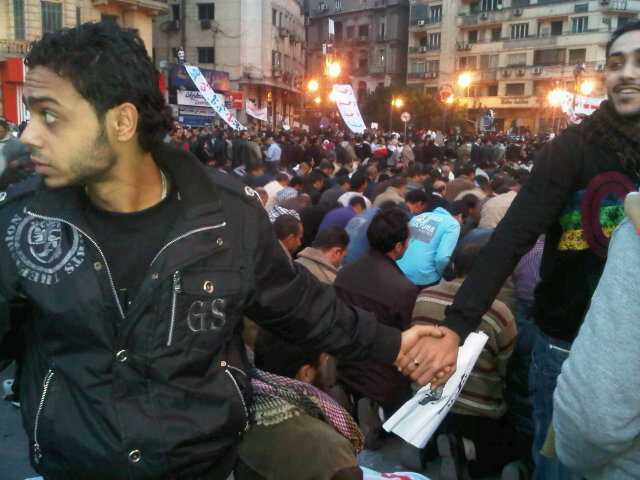
Many of you have likely seen this picture that Nevine Zaki posted in 2011, depicting Christians in Egypt protecting Muslims during prayer:
identity
Fourteen Points
On April 27, 2001, the members of Courage Seattle met with then-Seattle Auxiliary Bishop George Thomas (now the Bishop of Helena, Montana). Before his consecration as Bishop, Fr. Thomas played an instrumental role in encouraging the creation of a chapter of Courage in Seattle. With the Chapter up and running, he graciously consented to meet with us to see how things were going and to encourage the ministry.
In preparation for Bishop Thomas’s visit, we prepared the following Fourteen Point summary of the approach to ministry we had adopted in Courage Seattle.
 † CHRIST THE CENTER We place Christ at the center of our existence, subordinating all other aspects of our lives and pledge fidelity to Him without counting the cost.
Orientation Change vs. Mixed Orientation Marriage
I wanted to talk about the difference between a narrative of “orientation change” and one of “mixed orientation marriage,” and how I see that from a Catholic perspective.
I’ve struggled for a long time with the notion of “sexual orientation.” In some ways, the Courage party line, that there are no homosexuals, just heterosexuals with same-sex attraction, is true. Ontologically, theologically, it would seem to be a justifiable statement. The problem is, no one really talks ontologically in daily life. We say “I’m depressed,” not “I am a human being who is experiencing depression,” or “I’m a Liverpool fan” not “I am a person with Liverpool Football Attractions (LFA).”
The difficulty with this in terms of the “gay” debate, is that a lot of people do intend the term “gay” or “queer” ontologically. Today this is perhaps less true than it was in the 90’s, but the basic meme “I’m gay. That’s who I am” is still alive and well and living in San Francisco. This means that if someone like myself, or Josh Gonnerman, says “I’m gay/queer…and Catholic, and chaste,” it raises some eyebrows. Do I mean that I’m “queer” in the depths of my identity, that I am a queer child of God, or am I using language casually, I’m “queer” in the same way that I’m a board-game geek?
When the Gay Eclipses God
I fell in love with Jesus when I was a little girl. I remember sitting by the pond with my blue Snoopy fishing pole, marveling over the magnitude of the story of Jesus in my soul. Something about the stars and still water and inner dialogue with the writer of the world moved me to wonder. I memorized the book of Philippians when I was in middle school because I was captured by the God Paul described when he counted all things worth losing in order to know Christ—in order to connect with his creator. My understanding of what it all meant was surely immature, but I understood the message even more than I do now: Jesus Christ is the most magnificent, beautiful, breath-taking reality in the world, and if you get nothing else for the rest of your life then get Jesus.
A Note on Jesus and “Masculinity”
Looking through some old files on my computer today, I stumbled across an essay by Michael Horton, professor of Westminster Seminary in California, taking on the “New Calvinists”’ recent fixation on a certain version of “masculinity”. My early spiritual and theological formation happened in the evangelical Reformed wing of Christianity, and I continue to follow many of the discussions happening in Reformed circles. So this was doubly fascinating to me:
In the drive to make churches more guy-friendly, we risk confusing cultural (especially American) customs with biblical discipleship. One noted pastor has said that God gave Christianity a “masculine feel.” Another contrasted “latte-sipping Cabriolet drivers” with “real men.” Jesus and his buddies were “dudes: heterosexual, win-a-fight, punch-you-in-the-nose dudes.” Real Christian men like Jesus and Paul “are aggressive, assertive, and nonverbal.” Seriously?
The back story on all of this is the rise of the “masculine Christianity movement” in Victorian England, especially with Charles Kingsley’s fictional stories in Two Years Ago (1857). D. L. Moody popularized the movement in the United States and baseball-player-turned-evangelist Billy Sunday preached it as he pretended to hit a home run against the devil. For those of us raised on testimonies from recently converted football players in youth group, Tim Tebow is hardly a new phenomenon. Reacting against the safe deity, John Eldredge’s Wild at Heart (2001) offered a God who is wild and unpredictable. Neither image is grounded adequately in Scripture. With good intentions, the Promise Keepers movement apparently did not have a significant lasting impact. Nor, I predict, will the call of New Calvinists to a Jesus with “callused hands and big biceps,” “the Ultimate Fighting Jesus.”
Are these really the images we have of men in the Scriptures? Furthermore, are these the characteristics that the New Testament highlights as “the fruit of the Spirit”—which, apparently, is not gender-specific? “Gentleness, meekness, self-control,” “growing in the grace and knowledge of the Lord Jesus Christ,” “submitting to your leaders,” and the like? Officers are to be “apt to teach,” “preaching the truth in love,” not quenching a bruised reed or putting out a smoldering candle, and the like. There is nothing about beating people up or belonging to a biker club.
“Gay”: Clarity or Obfuscation? (Part 2)
In my last post, I pointed out the way that some Christians have exploited the ambiguous meaning of the word “gay” to make misleading promises (like “You don’t have to be gay”) to others.
Today, I want to look at how the word is sometimes used to mislead others—including other Christians—about the speaker’s own life and experiences.
Consider, for example, the sad case of Dr. George Rekers. He helped co-found the Family Research Council, and was for many years a member of the board and scientific advisor for the National Association for Research and Therapy of Homosexuality (NARTH). He was a leading opponent of gay rights and advocate of reparative therapy for several decades.
In 2010, he hired a man who worked as a male prostitute to accompany him on a trip to Europe. Allegedly, his travel assistant provided him with daily sexual massage services during the trip.
When these accusations became public, Dr. Rekers denied that he was gay.
This is “gay”
This is the fourth in a series of posts looking at my Catholic Faith, and how it relates to my life and my sexuality. Click to see the first, second, and third installments.
The term “gay” can be both descriptive and constructive. It can be used as a term to describe particular emotions, sentiments, orientations, and actions. Or it can be used as a means by which one identifies oneself and one’s relation to the world. The word “Catholic” is always both constructive and descriptive. It describes one’s religious affiliation, but it is also a means of identification and construction; it becomes a center upon which one builds one’s life. It is not used merely to describe one’s beliefs. Rather, it dictates a way of life and has a command and affect on how we view ourselves. An identification with “Catholic” implies radical change and carries constructive force.
My Early Education
This is the third in a series of posts looking at my Catholic Faith, and how it relates to my life and my sexuality. Click to see the first and second installments.
I consider it a strength of my early upbringing that the particularities of sexual identity were not a primary topic of discussion. Although words like “gay,” “straight,” and “bisexual” were known to me, I felt no urgent need to make these categories a significant part of how I viewed myself.
From the age of about five, I attended St. Joseph Catholic School in Bryan, Texas. It was a small parish school; I don’t recall my class size ever exceeding thirty-five students. I grew up in a loving family, with a mother, a father, a brother eighteen months younger than me, and a sister about three years younger than him.
Chris: This Is Me
This is the first in a series of posts looking at my Catholic Faith, and how it relates to my life and my sexuality.
For a time now, I have been engaging in intense self-reflection, considering the direction that my life seems to be taking and the ways in which I can develop as a Catholic and as a human being. It seems to me that many Catholics today are confused about their relationship to the Church and its teachings about sexuality. Many are unsure of whether they can find a place in the Church. They feel alienated by misunderstandings, confusions, misrepresentations, unjust caricatures, and unfounded discriminations.
I count myself as among these Catholics. And I’ve realized that, if I am going to get past these obstacles, it is time for me to be open about myself and to reach out to others who are like me.
The main point of this post is the firm and frank admission: I’m gay.
Intrinsically Disordered? How Not to Talk About Homosexuality
If there is one thing we can learn from Pope Francis’s recent comments on gay Christians, it is that style matters. Francis said nothing other recent popes haven’t said, but the winsome way he said it earned him a hearing from many for whom Catholic teaching on homosexuality is considered toxic.
Many Catholics have expressed disquiet with the form in which that teaching has been presented in recent decades, and in particular with the Church’s oft-repeated claim that homosexuality is “intrinsically disordered.” Less has been said, however, about what the Church might say instead of this.
As Eve Tushnet points out, “you can’t have a vocation of not-gay-marrying and not-having-sex.” It’s important not to reduce what the Church has to say to gay people merely to its teaching on sex. But while not-having-sex is only a small part of what the Church has to say, it is worth thinking about how it could be better presented, given that the ham-fisted way in which this particular teaching is presented often causes significant damage to the Church’s relationship with the gay community.
 Spiritual Friendship
You must be logged in to post a comment.