
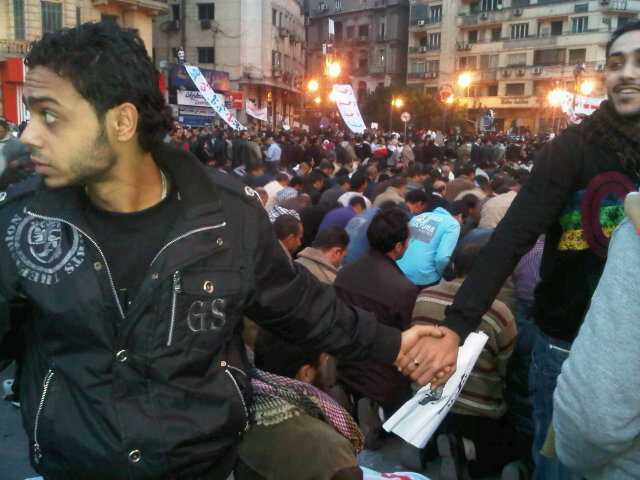
Many of you have likely seen this picture that Nevine Zaki posted in 2011, depicting Christians in Egypt protecting Muslims during prayer:
labels
Sexual Orientation: Is That Even a Thing?
The United States Conference of Catholic Bishops (USCCB) recently established an online resource entitled Marriage: Unique for a Reason, to educate Catholics on why marriage “should be promoted and protected as the union of one man and one woman.”
Done properly, this is an important task. But it must be remembered that the debate about gay marriage is less about homosexuality than it is about the nature and purpose of marriage as an institution and as a sacrament. Precisely because we are in need of sound teaching on this topic, it is disappointing to see the USCCB’s website—whose posts are written by anonymous “staff” rather than by bishops—used not to teach about marriage, but as an opportunity for promoting half-baked theories about homosexuality.
Orientation Change vs. Mixed Orientation Marriage
I wanted to talk about the difference between a narrative of “orientation change” and one of “mixed orientation marriage,” and how I see that from a Catholic perspective.
I’ve struggled for a long time with the notion of “sexual orientation.” In some ways, the Courage party line, that there are no homosexuals, just heterosexuals with same-sex attraction, is true. Ontologically, theologically, it would seem to be a justifiable statement. The problem is, no one really talks ontologically in daily life. We say “I’m depressed,” not “I am a human being who is experiencing depression,” or “I’m a Liverpool fan” not “I am a person with Liverpool Football Attractions (LFA).”
The difficulty with this in terms of the “gay” debate, is that a lot of people do intend the term “gay” or “queer” ontologically. Today this is perhaps less true than it was in the 90’s, but the basic meme “I’m gay. That’s who I am” is still alive and well and living in San Francisco. This means that if someone like myself, or Josh Gonnerman, says “I’m gay/queer…and Catholic, and chaste,” it raises some eyebrows. Do I mean that I’m “queer” in the depths of my identity, that I am a queer child of God, or am I using language casually, I’m “queer” in the same way that I’m a board-game geek?
“Celibates Lead Us in Our Anticipation of That Eternal Joy”
My friend Fr. Stewart Ruch III, the newly elected Anglican (ACNA) bishop of the Diocese of the Upper Midwest, was recently interviewed about a sermon he gave on celibacy. For many years, Fr. Stewart has been the rector of Church of the Resurrection in Wheaton, Illinois, and in this interview he draws on several conversations he had with celibate members of his parish.
Here’s a taste:
I wanted to talk about a larger issue than just human marriage or singleness. I wanted to talk about the very goal of human personhood. God in Christ wants to marry humanity. He chose spiritual marriage, the great marriage of our souls with God, as a kind of beatific vision, the end goal of all of our personhood. Marriage with God is a dramatic biblical metaphor for God’s relationship with his people.
The concept of “singleness” can’t do justice to this. For one thing, no one is autonomous or truly “single.” When we realize this, we begin to see that every person is profoundly connected, and has the ultimate destiny of absolute communion with God.
Often, the problem in the church is that “singles” get left behind. We subtly communicate that marriage and raising a family is the “big deal” of Christianity. That’s incomplete. Celibacy, just like marriage, points us towards the real big deal—the marriage of God in Christ with humanity. A celibate Christian can be a sign of living faithfully into that marriage. Celibacy is a far more rounded, nuanced, positive word to say what our theology calls us into. I call those embracing this lifestyle “celibate” because they’re actually being called to live in full marriage with God as a picture of what we’re all going to be when there’s no giving and taking of marriage in heaven.
Read the whole thing.
All the Celibate Ladies? A Different Question About Labels and Language
Last week I had a great lunch w/another gay Christian woman. We differ pretty strongly on how one follows Christ, both in terms of communion/church (she’s a Protestant) and, relatedly, in terms of chastity. But the difference which I found most striking wasn’t a difference in belief; it was our respective emotional responses to some of the terms people use to describe “my side” of the Christian discussion of sexual orientation and chastity.
My new friend described me as “single,” which for her was a neutral to positive term. “Celibate,” which is the term I usually use for myself, sounded really negative to her. I wish we’d talked about this longer, since I don’t know exactly what she associated with “celibacy”: repression, frigidity, spinsterhood, perversion? I do know what I associate with the term “single,” though: stressed-out straight women made miserable by the unhappy prospect of dating (or, and this is sometimes even worse, not dating) straight men.
“Gay”: Clarity or Obfuscation? (Part 2)
In my last post, I pointed out the way that some Christians have exploited the ambiguous meaning of the word “gay” to make misleading promises (like “You don’t have to be gay”) to others.
Today, I want to look at how the word is sometimes used to mislead others—including other Christians—about the speaker’s own life and experiences.
Consider, for example, the sad case of Dr. George Rekers. He helped co-found the Family Research Council, and was for many years a member of the board and scientific advisor for the National Association for Research and Therapy of Homosexuality (NARTH). He was a leading opponent of gay rights and advocate of reparative therapy for several decades.
In 2010, he hired a man who worked as a male prostitute to accompany him on a trip to Europe. Allegedly, his travel assistant provided him with daily sexual massage services during the trip.
When these accusations became public, Dr. Rekers denied that he was gay.
This is “gay”
This is the fourth in a series of posts looking at my Catholic Faith, and how it relates to my life and my sexuality. Click to see the first, second, and third installments.
The term “gay” can be both descriptive and constructive. It can be used as a term to describe particular emotions, sentiments, orientations, and actions. Or it can be used as a means by which one identifies oneself and one’s relation to the world. The word “Catholic” is always both constructive and descriptive. It describes one’s religious affiliation, but it is also a means of identification and construction; it becomes a center upon which one builds one’s life. It is not used merely to describe one’s beliefs. Rather, it dictates a way of life and has a command and affect on how we view ourselves. An identification with “Catholic” implies radical change and carries constructive force.
“Gay”: Clarity or Obfuscation? (Part 1)
In contemporary culture, “gay” is the most common word for describing homosexual persons. This has become so much a part of the default language that Pope Francis used it as a neutral description of a person’s sexual attractions in response to a question at a recent press conference.
I think a lot of the language debates that go on around homosexuality make mountains out of molehills (I could link to examples, but why give traffic to posts I think are hurting the discussion?). I am more interested in talking about vocation, friendship, celibacy, and other questions which I think address more important needs.
Still, language can cause confusion, and stirs up a lot of debate. So I’m going to say something about it, even though I think the arguments have been blown out of proportion.
Chris: This Is Me
This is the first in a series of posts looking at my Catholic Faith, and how it relates to my life and my sexuality.
For a time now, I have been engaging in intense self-reflection, considering the direction that my life seems to be taking and the ways in which I can develop as a Catholic and as a human being. It seems to me that many Catholics today are confused about their relationship to the Church and its teachings about sexuality. Many are unsure of whether they can find a place in the Church. They feel alienated by misunderstandings, confusions, misrepresentations, unjust caricatures, and unfounded discriminations.
I count myself as among these Catholics. And I’ve realized that, if I am going to get past these obstacles, it is time for me to be open about myself and to reach out to others who are like me.
The main point of this post is the firm and frank admission: I’m gay.
Intrinsically Disordered? How Not to Talk About Homosexuality
If there is one thing we can learn from Pope Francis’s recent comments on gay Christians, it is that style matters. Francis said nothing other recent popes haven’t said, but the winsome way he said it earned him a hearing from many for whom Catholic teaching on homosexuality is considered toxic.
Many Catholics have expressed disquiet with the form in which that teaching has been presented in recent decades, and in particular with the Church’s oft-repeated claim that homosexuality is “intrinsically disordered.” Less has been said, however, about what the Church might say instead of this.
As Eve Tushnet points out, “you can’t have a vocation of not-gay-marrying and not-having-sex.” It’s important not to reduce what the Church has to say to gay people merely to its teaching on sex. But while not-having-sex is only a small part of what the Church has to say, it is worth thinking about how it could be better presented, given that the ham-fisted way in which this particular teaching is presented often causes significant damage to the Church’s relationship with the gay community.
 Spiritual Friendship
You must be logged in to post a comment.