‘Til Death Do Us Part (and Why That’s About Friendship Too)

Screen Shot 2014-08-29 at 8.26.49 AM

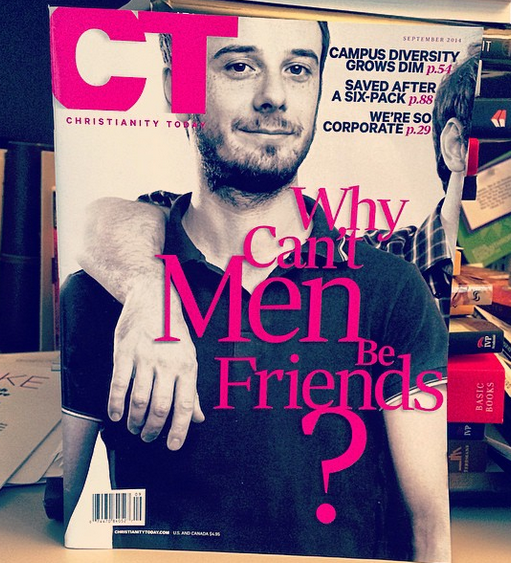
I wrote the cover story for this month’s issue of Christianity Today on—you guessed it!—friendship.

A lot of what I say in the piece grew out of conversations here at SF, and I am truly grateful to you all for reading and thinking with me over the past months about these things. A fuller version will appear in my forthcoming book, but until then, here’s a teaser trailer:

I imagine a future in the church when the call to chastity would no longer sound like a dreary sentence to lifelong loneliness for a gay Christian like me. I imagine Christian communities in which friendships are celebrated and honored—where it’s normal for families to live near or with single people; where it’s expected that celibate gay people would form significant attachments to other single people, families, and pastors; where it’s standard practice for friends to spend holidays together or share vacations; where it’s not out of the ordinary for friends to consider staying put, resisting the allure of constant mobility, for the sake of their friendships. I imagine a church where genuine love isn’t located exclusively or even primarily in marriage, but where marriage and friendship and other bonds of affection are all seen as different forms of the same love we all are called to pursue.

By shifting our practice of friendship to a more committed, honored form of love, we can witness—above all—to a kingdom in which the ties between spiritual siblings are the strongest ties of all. Marriage, Jesus tells us, will be entirely transformed in the future, barely recognizable to those who know it in its present form (Matt. 22:30). Bonds of biology, likewise, are relativized in Jesus’ world (Mark 3:31–35). But the loves that unite Christians to each other across marital, racial, and familial lines are loves that will last. More than that, they are loves that witness that Christ’s love is available to all. Not everyone can be a parent or a spouse, but anyone and everyone can be a friend.

Read the whole thing.

An Impatience with Biblical Exegesis

I want to try to comment on a—what to call it? a trend? a mood?—I’m seeing in the ongoing Christian conversations and debates about same-sex marriage. I’d like to call it an impatience with biblical exegesis, and here’s what I mean by that:

When I go and speak in various venues about Christian faith and sexuality, I hear comments like the following with more and more regularity: “We know that both sides aren’t going to agree about what the Bible says. And we know that both sides already know which are their favorite verses and how they interpret them, so we’re not going to change each other’s minds. But what we can do is share our stories with one another. We can learn to understand each other’s lives better. We can gain more empathy for each other. So let’s focus on that rather than having yet another ‘debate’ about the Bible.”

I want to add quickly that I’m not immune to this mood either! As Robert Gagnon pointed out yesterday about my recent public conversation with Justin Lee in Grand Rapids, I talked very little about my reading of biblical texts and spent much more time “telling my story.” I share the temptation that many others of my generation face to believe that talking about the Bible won’t lead to any resolution and so we’re better off simply trying to understand one another’s hopes and fears and offer support where we can. Where the Bible is too divisive, sharing our Christian stories can be something that unites us.

Continue reading

Coming Out and Being Open

I “came out” just about a year ago. It’s odd looking back on the days when no one knew and comparing those days to my life today, partly because my life looks so different and partly because my life looks so similar. I’m still here. I’m still Catholic. And I’m still the kind of Catholic who affirms everything in that little book we call the Catechism.

But I’m also so different. It’s as if my life were an iceberg and coming out was the decision to let others finally see what was beneath the surface. They had always seen me, but they had also missed out on so much of what puts me together, what lies hidden and holds me up, what gives my life the unique shape and color that it has always had. And coming out has let me look beneath the surface of myself as well.

Continue reading

One More Post on the “Gay” Bonhoeffer

We’ve been over this ground before—see here and here—and I don’t want to beat a dead horse (especially since my review will be out in September and I’ll be linking to that here too!), but I was really struck by Charles Marsh’s comments from a few days ago on the Dietrich Bonhoeffer/Eberhard Bethge relationship as portrayed in his biography Strange Glory: A Life of Dietrich Bonhoeffer.

In an interview at Religion and Politics, Marsh was asked this:

I want to switch gears to a more personal aspect of the book. You make the case that Bonhoeffer experienced a kind of romantic love or attraction to his best friend Eberhard. While you write that the relationship remained chaste, the notion that Bonhoeffer might have been gay has received a lot of attention in some quarters. So number one, I wondered, was this finding a surprise to you in your research? And what have you made of reactions to it?

Continue reading

What I Learned From My Ex-Gay Days Part 2: Reflections

In my previous piece, I described my experience trying to change my orientation. As promised, in this post I will discuss some practical insights, many of which extend beyond the ex-gay context in which I learned them.

The most immediate insight is directly about sexual orientation change efforts: change in orientation is not something we should promise. Hope in orientation change can be false hope. This is true even for someone who is willing to put great effort into trying to become straight and, more importantly, dealing with the sorts of issues often claimed to be behind a homosexual or bisexual orientation. It is important that we be honest.

Putting my hope into orientation change had less fallout for me than it had for many others. As a man who was already attracted to women, changing my orientation was never quite about being able to function in a marriage. Remaining attracted to the same sex did not have any particular implication about celibacy; it merely meant that I could not be as normal as I wanted and that I would face negative attitudes from some conservative Christians. I was able to come to an acceptance of this reality. However, other people do experience significant hurt. As I alluded to in the first part, even parents may be unnecessarily hurt when they take the blame for their children’s orientation.

Continue reading

How to Narrate Complexity

I finally watched Desire of the Everlasting Hills, a recent hour-long film that’s gotten a lot of attention in our circles of late. It tells the stories of three Catholics who, at least at one time, understood themselves to be homosexual but now, in light of their return to the Church… well, you’ll just have to watch it and see how unpredictable and multi-layered their narratives are. As Eve Tushnet has pointed out, these are by no means simple “ex-gay” stories, but nor, I think, are they exactly the sort of stories we often highlight on this blog. I thought I had heard most everything in our little gay Christian world, but this movie surprised me.

One of the things that especially stood out was the way each of the three subjects managed to narrate complexity at each stage of their journey. It’s one thing to tell a “before and after” story, in which confusion is succeeded by order, or vice versa. But this movie includes genuine mystery and complexity in every chapter; a too-tidy, answer-dispensing resolution never arrives.

Continue reading

What I Learned from my Ex-Gay Days Part 1: My Experience

Like several other bloggers on Spiritual Friendship, I had a period of my life when I was actively trying to change my sexual orientation. Although my perspective has shifted dramatically since then, I learned some important lessons through my experiences. In order to reflect on those lessons, I am posting a two-part series. In this piece, I will discuss my experiences with ex-gay approaches. In a follow-up piece, I will discuss some practical insights, many of which are broader than the ex-gay context in which I first learned them.

As I’ve mentioned before, I discovered the ex-gay movement during my later teenage years, and I initially understood references to being “formerly gay” or having “overcome homosexuality” as becoming completely straight.

Much of the ex-gay literature comes from a particular perspective about how same-sex feelings arise. I never really bought the most common claim, which was that my attractions arose from a defect in my relationship with my father. I knew that, while not absolutely perfect, my relationship with my dad was a good one. The prevalence of this explanation in the ex-gay literature, however, did cause some hurt and frustration when I first told my dad about my sexuality. Though I didn’t blame him, I could tell he was concerned he may have done something wrong.

Continue reading

Between Two Weddings

Two years ago, as I was just beginning to think more critically about my faith and sexuality, I attended a wedding. It has been interesting to revisit the memorialized emotions that accompanied the ceremony, to examine the well-worn paths down which my uncertain thoughts routinely fled when confronted by longing and sorrow.

Wedding Rings

Weddings used to primarily remind me of all I couldn’t have, my easily startled psyche darting away from the encroaching shadows of jealousy and isolation. I would think, over and over, “I want this. I still want this.” There was always a bitter ache, a subcutaneous anxiety. Pain threatened my convictions and wove itself into every sensation. Unsurprisingly, I imagined that watching my best friend get married would be a similar experience, just exponentially moreso.

I was wrong.

Continue reading

Mourning the Loss of My Friend Chris

Here’s a more immediately personal post than I often write.

I’ve just lost one of my best friends, and I thought it would be appropriate to share here at Spiritual Friendship the remembrance I wrote of him. It’s been posted over at Books & Culture, and you can read the whole thing there. For now, an excerpt:

When I stepped off the train in Oxford, Chris was standing there in the station waiting for me, his face breaking into its characteristic goofy grin when I landed on the platform, but he didn’t stay still longer than it took to give me a tight hug. He pivoted as soon as he released my shoulders, grabbed one of my bags, and sped toward the rental car. We were already late for the adventure he had planned. We were going to drive from Oxford to the little village of Wolvey in Warwickshire, roughly 115 kilometers away, to look for a tombstone.

When Chris was growing up in Oregon, his family employed an Englishman named William Alcott Bailey as a part time gardener and handyman. Chris learned the value of hard work, he said, from Bailey. He learned how to work with his hands and see a yard project through to its finish, but, even more, he learned how to take ownership and pride in his work. He learned those things, specifically, from Bailey. And now, in between his other responsibilities in the UK, lecturing and researching for a new edition of one of C. S. Lewis’ books, he wanted to go looking for Bailey’s grave, as a way of paying tribute to someone that, in retrospect, he viewed as essential to the arc of his childhood. He knew Bailey had spent his childhood in Wolvey, but that was about it. Whatever leads he had had petered out there. We’d just have to look for the tombstone, assuming that Bailey would have wanted to be buried where he grew up.

I wish I could capture the simultaneity of Chris’ fiercely serious fixation on this task and his boyish, smiling enthusiasm for being on a quest. It wasn’t unusual for him—that combination of zeal and playfulness is what had made me want to be friends with him from the beginning—but it was what made Chris unique. And I wasn’t the only one who loved him for it, but, nonetheless, I treasured the feeling that this particular glimpse into it was mine. This was a special trip for just the two of us, a way for me to learn more about my friend’s upbringing and to delight in what made him happy.

We never found William Alcott Bailey’s grave. We traipsed around the overgrown C of E parish cemetery, uncovering some Baileys that Chris was convinced were his Bailey’s relations, but as far as we could tell, there was no “William Alcott.” Undeterred, we went to the pub anyway to toast him. At the Blue Pig just down the road—I still remember sitting across from Chris at our table by the window, with the glint of summer evening sun caught in our pint glasses—we hoisted our ales “to William Alcott Bailey and his good memory.” Afterwards, we lit pipes and walked the length of the empty fields behind the pub and talked. The conversation was vigorous, spirited, meandering, as it always was with Chris, with both of us talking over each other at various junctures, stalled only by moments of concentration for an occasional relight.

Chris later said that trip to Wolvey cemented our friendship. I inwardly beamed whenever I heard him tell the story—as I did many times in the intervening years—to others.

Chris was for many years the director of The Marion E. Wade Center at Wheaton College and he was for the past year professor of theology at the Torrey Honors Institute at Biola University. He died last Thursday evening, July 10. He was an exemplary scholar, teacher, mentor, and friend to many. But more than that, he was a Christian who believed in the hope of the resurrection. May he rest in peace and rise in glory.

The Labor of Love

Imagine a man who quits his job and moves across the country for the woman he loves. This act is either incredibly beautiful or incredibly stupid. One critical fact makes the difference: how she responds.

“Love at first sight” only works for those who have not learned the labors of love. For how can one love another when he does not yet know how to love the other? The greatest love is less like a disembodied hook-up and more like one striking image from John Green’s The Fault in our Stars (the tragically funny book, which I saw as a movie and laughed when I wasn’t supposed to—sorry, fellow movie-goers!). The protagonist reflects, “I fell in love the way you fall asleep: slowly, and then all at once.”

A love which is truly for the other is a slow love, because it is a patient love. It does not demand that the beloved immediately open himself until he is ready. And it is a love that constantly adjusts itself as more of the other is revealed. It constantly adjusts its giving according to the beloved’s need. And if the beloved is not prepared to receive love, it will not thrust itself upon the beloved.

Continue reading