Aelred in Modern Dress

Here’s something I wish I’d seen when I was doing research for my friendship book—a wonderfully pastoral essay by scholar Timothy Lim Teck Ngern on how to live out Aelred’s vision of spiritual friendship in contemporary Western cultures.

Consider this very human paragraph:

Why does friendship hurt? Life is messy, and sometimes, even with preventive measures (such as setting good boundaries and demonstrating mutual reverence), heartaches still knock at our doors. The reciprocity of love as the fountain and source of friendship would imply that if a friendship hurts, it is often due to differing degrees of reciprocity between friends. It is like the case of Jerome’s disappointment with Heliodorus or William of St. Therry’s question to Bernard of Clairvaux that “you did not love me as I did you” (note: not to be interpreted with any sexual overtones). To a large extent, the degrees of reciprocity depend on the nature of the friendship in Aelred’s conception, whether it is carnal, worldly, or spiritual. In essence, friendship hurts because friends disappoint us, regardless of their intentionality, and because we live in a world characterized by jealousy, possessiveness, and selfishness.

I tried to write about these sort of heartaches in my book, and I hope to say more about that in another post soon, in dialogue with some thoughts from my friend Tim Otto.

And yet—

Aelred embraces a biblical notion that a friend loves at all times, even when friends falter; it would suggest that forgiveness is possible. On the limits of friendship in Book II, he acknowledges that those who previously followed wayward paths of lusts and avarices may return to fellowship if they are learned to control over their inordinate affections and behaviors. He further postulates that if Christ forgives us and asks us to love our enemies like friends, then, there can be forgiveness however difficult it may be. Some may read Aelred’s comment on distancing from the wayward as an act of judging others. However, the Aelredian paradigm is not an act of casting aspersion, but that of inner discernment, so as to admit into closer friendship with those who show signs of desiring a godly life.

If I wanted to give someone a quick digest of the wisdom of Aelred of Rievaulx on friendship, I’d probably point them now to this gently instructive essay.

Theologues Podcast: Melinda Selmys and Mark Yarhouse on Gender Dysphoria

Theologues recently hosted a podcast to discuss gender dysphoria with Melinda Selmys and Mark Yarhouse.

Yarhouse-Selmys

In spring of 2015, Bruce Jenner announced to the world that he would become Caitlyn Jenner and the conversation about gender and transgender issues exploded into our culture. How do we approach these issues? When real biology and psychology are involved, how do we approach it?

Zach spoke with Melinda Selmys (writer and author of Sexual Authenticity: An Intimate Reflection on Homosexuality and Catholicism and blogs at Catholic Authenticity) and Mark Yarhouse (psychologist and author of Understanding Gender Dysphoria: Navigating Transgender Issues in a Changing Culture) about approaching gender dysphoria, sexual reassignment, gender expression in children and how Christians can approach these issues in a changing culture.

We highly recommend this episode to anyone who wants to know more about transgender issues and the pastoral way to approach this issue while keeping a consistent Christian ethic which upholds God’s created order while loving people where they are.

Melinda also recommends her second book “Sexual Authenticity: More Thoughts” and we recommend her Theologues article, Is There a Place for Transgender in the Church?

Go over to Theologues to listen to the full podcast.

Friendship Roundup

Spiritual Friendship has published over 400 posts by now, all of which are related to friendship in one way or another. This “roundup” post simply tries to collect some of the posts which will be the most helpful in introducing new readers to the main ideas of this blog.

Friendship and covenant is an important theme in Scripture. Abraham, the great father of all who share his faith (Romans 4:16) is also called a friend of God (2 Chronicles 20:7; James 2:23). God “spoke to Moses face to face, as a man speaks to his friend” (Exodus 33:11). David and Jonathan form a covenant with each other (1 Samuel 18:3), and David says of Jonathan, “your love to me was wonderful, passing the love of women” (2 Samuel 1:26). And at the Last Supper, Jesus calls His disciples friends (John 15:15). Friendship has also been an important part of the Catholic Church’s pastoral approach to homosexual persons.

Spiritual Friendship in 300 Words provides a concise overview of how Ron Belgau learned about spiritual friendship from a 12th-century Cistercian abbot named Aelred of Rievaulx. In Three Kinds of Friendship, he explains the same ideas in greater depth, and in Some Theses on Friendship, he discussed some of the important themes he hopes to explore in this blog.

In Is Friendship an Unconditional Love? and The Problem of Monastic Cliques, Wesley Hill examines the dangers of exclusivity in friendship. In Friendship and the Scandal of Particularity, Ron Belgau responds by pointing out that there is a legitimate need for the specificity of Friendship. Gregg Webb explores some of the differences between the commitment of friendship and the commitment of marriage. Also relevant to this discussion are Eve Tushnet’s thoughts on Detachment in Friendship and Thomas Aquinas’s discussion of the relationship between friendship and charity.

The Catechism of the Catholic Church says that says that homosexual persons need the support of disinterested friendship.” This term is a frequent cause of confusion, which Ron Belgau helps to clear up.

Is there such a thing as Friendship at First Sight? Ron Belgau explores some of C. S. Lewis’s writings on this subject.

Finally, he shares about his own experiences with friendship, and Wesley Hill shares about his friendship with Ron Belgau.

What Does “Disinterested Friendship” Mean?

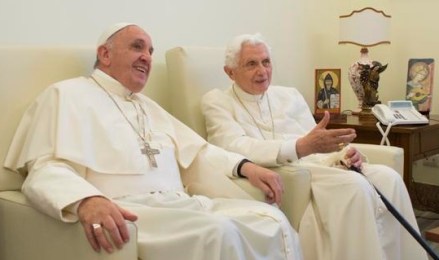
Popes Francis and Benedict

The Catechism of the Catholic Church uses the term “disinterested” in five different places. The most relevant instance for most readers of this blog is:

2359 Homosexual persons are called to chastity. By the virtues of self-mastery that teach them inner freedom, at times by the support of disinterested friendship, by prayer and sacramental grace, they can and should gradually and resolutely approach Christian perfection.

The first definition for “disinterested” at Dictionary.com is “unbiased by personal interest or advantage; not influenced by selfish motives,” which would mean that a “disinterested friendship” is a friendship that is not biased by personal interest or advantage, nor influenced by selfish motives. In the context of 2359, the most obvious selfish motive in view would be lust, though any selfish motive will poison friendship. This unbiased and unselfish friendship seems like the sort of love most of us would want from our friends.

However, the second definition for “disinterested” is “not interested; indifferent.” A usage note points out that

Disinterested and uninterested share a confused and confusing history. Disinterested was originally used to mean “not interested, indifferent”; uninterested in its earliest use meant “impartial.” By various developmental twists, disinterested is now used in both senses. Uninterested is used mainly in the sense “not interested, indifferent.” It is occasionally used to mean “not having a personal or property interest.”

And, this confusion infects many people’s understanding of the term “disinterested friendship” in 2359. To many, “disinterested friendship” suggests a friend who is “not interested, indifferent.” Comparison with other usages of the same word in the Catechism, however, demonstrates that this cannot be the sense the authors of the Catechism had in mind.

2649 Prayer of praise is entirely disinterested and rises to God, lauds him, and gives him glory for his own sake, quite beyond what he has done, but simply because HE IS.

Continue reading

Matt Jones at OnFaith: Avoiding Hypocrisy as the Church

matt_001Spiritual Friendship writer Matt Jones recently contributed to a series on sexuality and the church over at OnFaith, focusing on ways his current church community is modeling a traditional sexual ethic that avoids much of the hypocrisy found in more conservative churches. Some excerpts:

When I joined, I simply became a part of that redemptive movement. This is an enormous blessing, because — believe it or not — I really want to proclaim the gospel through ministry and advocacy. (And, as a white dude brimming with privilege, learning how to do this in a way that doesn’t reinforce inequality can be a challenge!) I want to be a Christian, and I want my church to urge the congregants on in our shared vocation of pursuing justice for the marginalized (which includes a sizable portion of the church population itself).

Often lgbt+ Christians are treated as if we have one job this side of Jesus’ return: don’t have gay sex. But, as Eve Tushnet so quotably stated, “You can’t have a vocation of no,” of only avoiding something. We need something to live for, and let me say that Christianity never makes more sense to me than when I am witnessing or participating in a Christian community that is unified toward imitating and proclaiming Jesus’ liberative gospel.

And:

It continues to amaze me how hard celibate lgbt+ people have to work to find space in churches that claim a more traditional sexual ethic. The social burdens experienced by sexual minorities in these communities vary widely, but usually include increased scrutiny and suspicion, painful comments from congregants who may or may not know about one’s sexuality, reduced ministry possibilities (e.g. I was once stripped of an internship and prevented from helping with a youth group because I wasn’t trying hard enough to be straight), insanely exhausting language policing,**** and at times, the general ache of being single in a culture that over-valorizes marriage and romance to the detriment of thechurch’s calling to be family.

I’m not sure how churches decided that the best ‘defense’ of the traditional sexual ethic is to place excessive burdens on those trying to abide by it and then fail to provide the support structures that would make such an ethic intelligible and healthy . . . but, well, here we are.

I believe the traditional sexual ethic is beautiful and good — I try to live according to it for a reason! — but I also believe that the way churches have approached the topic of human sexuality has largely failed to do any justice to the scope and nuance of the doctrine and has, in fact, done injustice to countless people who should have found a home and family within the church, and this requires sincere repentance.

Read the Whole Article at FaithStreet.

The Questions We Ask

P_questionShould governments recognize civil marriages between two people of the same sex?

This question has been on the minds of many Americans in recent years. Last week it became largely a moot point in the United States, as a result of the Obergefell v. Hodges decision. My hope is that we can use this as an opportunity to rethink which questions we focus on.

There are many questions that Christians are asking about all things LGBT. Often, the focus has been on one particular question: Is sexual intimacy between two people of the same sex always sinful?

Clearly, this question is an important one, and its answer has many practical implications. Although I answer this question in the affirmative, I am frustrated when others who share that answer act as though this is the end of the discussion. This answer actually opens the door to quite a few further questions. Continue reading

Hoping for Love

jack-evans-800

My friend Alan Jacobs, a traditional sort of Anglican Christian, wrote this the day after the Obergefell ruling:

Perhaps I am soft on sin, or otherwise deficient in serious Christian formation — actually, it’s certain that I am — but in any case I could not help being moved by many of the scenes yesterday of gay people getting married, even right here in Texas. I hope that many American gays and lesbians choose marriage over promiscuity, and I hope those who marry stay married, and flourish.

I know what he’s saying. I felt that too.

But I was thinking more today, What is that experience? For those of us like me who hold to a Christian view of marriage that contradicts the SCOTUS definition, what does it mean to be moved by scenes of gay marriage?

Well, for starters—and I’m speaking for myself here, not necessarily for Alan—I think that for many, many (not all) gay people in America today, the options have not been (1) belong to a healthy, vibrant Christian community in which celibacy is held in high esteem and deep spiritual friendships with members of the same sex and opportunities for loving service and hospitality abound or (2) be in a romantic relationship with a partner of the same sex. That has not been the choice facing many gay and lesbian people. Instead, for many (not all) today, the options have been (1) be ostracized (or worse) in church and effectively live without meaningful same-sex closeness of any kind or (2) be in a romantic relationship with a partner of the same sex. Listen, readers, this is the reality for many gay people who have had a brush with the Christian church in recent years:

So many people have been told (explicitly) that they aren’t welcome, treated as problems rather than persons. They’ve been disowned, had their trust betrayed and their confidences exposed, been kicked out of their homes and their churches, threatened with expulsion. They’ve listened as preachers proclaimed that people like them were destroying the church, that their desires were uniquely and Satanically destructive, that homosexuality by its nature cut them off from God; that their only hope for a faithful Christian life was to repent of their homosexuality, become straight, and get married. All by Christians who claimed that their actions were the result of their faith in Jesus.

And often this abuse—I know labels can obscure complexity but in this case I think naming the abuse is important—is inflicted on people who are trying to live out the full Christian sexual ethic. The treatment they receive would be unjustifiable even if (and even when) they reject Christian teaching on homosexuality, but what’s sort of amazing is that simply self-identifying as gay or even “struggling with same-sex attraction” will earn you condemnation and shame in many Christian communities. Your shame is treated as a sign of faith; any hints of self-acceptance are treated as rejection of God. It should come as little surprise that many of the people who receive this mistreatment eventually reject (what I believe to be) the Christian sexual ethic, and often reject Christianity entirely.

So, I think part of the reason I got a lump in my throat on Friday as I was scrolling through news feeds and seeing gay friends’ pictures pop up on Facebook and Twitter is because I know that for so many of these people, the alternative to their current jubilation has been a gulf of loneliness and marginalization. I persist in believing in the traditional Christian picture of marriage—what G. K. Chesterton once called a “triangle of truisms,” i.e., “father, mother and child”—but I know that when many people depart from it, they’re doing so after undergoing a significant amount of ill-treatment.

Continue reading

The “Benedict Option” and the Dazzled Pagan Eye

After yesterday’s SCOTUS ruling on same-sex marriage (about which more here), there’s been a lot of chatter in my Twitter feed and email inbox about the so-called “Benedict Option”—the view that we traditionalist Christians, who continue to believe that marriage is the lifelong union of one man and one woman, are in a kind of cultural exile and that our calling, therefore, is to “a limited, strategic withdrawal… from the mainstream of American popular culture, for the sake of shoring up our understanding of what the church is, and what we must do to be the church” (as Rod Dreher puts it). In other words, a lot of my orthodox Christian friends are asking what it looks like to be faithful to Christian teaching now that the state’s definition of marriage diverges so widely from the church’s biblical and traditional definition.

One of the earliest posts I read on this approach was by the Duke Divinity School theologian Paul Griffiths, published years ago on his now (alas!) closed-down blog. Probably around 2006 or 2007, from what I can remember, Griffiths wrote this:

In the America of our day, it is about as difficult (or as easy) to make what the Church teaches about marriage comprehensible and convincing (the latter more difficult than the former) to the educated locals as it is to make the doctrines of the Immaculate Conception or the Real Presence so.

If that empirical claim is right… , then the conclusion strongly suggested by it is that the Church should not, at the moment, oppose legal recognition of same-sex unions. Those who have undergone a profoundly pagan catechesis on these questions will believe and behave as pagans do; it would be good for them and for the Church if the Church were not to attempt to constrain them by advocating positions in public policy based upon the view that what she teaches resonates in all human hearts—because it doesn’t, true though it is.

What the pagans need on this matter is conversion, not argument; and what the Church ought to do to encourage that is to burnish the practice of marriage by Catholics until its radiance dazzles the pagan eye.

Griffiths has since the time of this writing apparently shifted his views on same-sex marriage, but I’m not interested in exploring that change here. What I am interested in is Griffiths’ final sentence from this old blog post, which has haunted me ever since I first read it: The church’s calling now, and all the more so now that Griffiths’ hypothetical legalization of same-sex marriage is now the law of the land, is to burnish the practice of marriage until its radiance dazzles the pagan eye.

On the surface of it, I’m not sure how that strategy would work. How is it that Christians’ purifying of their own male-and-female marriages will work to convince, say, a happily satisfied pagan couple to give up their gay sex and convert to traditional Christianity? How is that, to return to the Benedict Option mentioned above, Christians’ strategic withdrawal from mainstream culture and our commitment to our own re-conversion will prove attractive to an indifferent, or hostile, pagan world?

I’m not sure what the answers to these questions are, but I am increasingly convinced those are precisely the questions to ask.

But let me go ahead take a stab anyway at imagining some answers.

Continue reading

An Initial Response to SCOTUS: Where Do We Look for the End of Loneliness?

Over at First Things, I’ve contributed to a symposium on yesterday’s SCOTUS ruling. The questions each of us were given to answer were these: “How should we respond to how the Supreme Court has ruled? What’s next?”

My answer started off with a riff on a really affecting gay memoir:

In his memoir Denial: My Twenty-Five Years Without a Soul, the gay journalist Jonathan Rauch says that there once existed a frightened young man tortured with the certainty that there was no place in the world for the love he experienced. That man was Rauch, and there was no home for him—none, that is, until he and his fellow Americans decided he had the right to marry. “They and he have found, at last, a name for his soul. It is not monster or eunuch. Nor indeed homosexual. It is: husband.”

When I read Rauch’s book, that last sentence left a lump in my throat. That receiving the word husband felt to Rauch like the relief of a negative biopsy—“You’re not sick or twisted or crazy; you’re just hindered from giving and receiving love, and now the hindrance is removed”—goes a long way toward explaining the jubilation so many gay and lesbian people feel in the wake of the Obergefell v. Hodges SCOTUS ruling. Finally, their loves may be dignified not with the anemic moniker friend or partner or the clinical epithet disordered or the disdainful slur pervert but rather with the venerable, ordinary, immediately recognizable words husband or wife.

You can read the rest of what I wrote by clicking through—basically, in my contribution, I fault us Christians, the churches themselves, for our complicity in promoting erroneous views of marriage (“we,” not just “them,” share the blame!)—but I wanted to take the opportunity here to say a little bit more.

Continue reading

Awe and Wonder: A Preliminary Comment on Laudato Si’

Pope Francis

Laudato Si is shaping up to be the most controversial papal encyclical since Humanae Vitae. On the surface, the dissent from these two encyclicals seems very different: the rebellion against Humanae Vitae came from the political “left,” while the present rebellion comes from the “right.” If, however, we dig beneath the shallow political categories, we find that the two rebellions are “ultimately due to the same evil: the notion that there are no indisputable truths to guide our lives, and hence human freedom is limitless” (LS, 6).

The “left” has focused more on sexual freedom, and the “right” on economic freedom. The fundamental question for both, however, is: can we discover a rational order in nature, put there by God, an order to which we are called to conform our lives? Or do we see in nature—including our own human nature—only raw materials to be exploited for ends that we choose for ourselves?

In Romans 1 and 2, the Apostle Paul makes clear that even without direct revelation, it is possible to learn of the Creator through Creation itself, and to discover His law written in our hearts. But most of us do not really want to discover these truths; instead, we want to serve our own desires.

How, then, can we begin to recover the harmony of Creator and creation described in Genesis 1 and 2?

Continue reading