A Love that Fills, and a Love that Opens

Some friends of mine were recently married. As a part of their wedding ceremony, they included the prayer:

“For those suffering from broken hearts and homes, from loneliness or the dread of it; and for all called to the generosity of the single or celibate; that they might inspire [name of bride and groom] by their conformity to Christ, and always find in them fiercely devoted friends, and in their house a second home.”

This is a rather odd prayer for American weddings, which are often primarily (or purely) celebrations of a “filling love” between the husband and wife. We often celebrate marital love as a love in which the man and woman are seen as fulfilling each others’ deepest desires, creating an insular community in which the couple is viewed as “enough” for each other. The couple is seen as creating a home for themselves, but not a home for others.

But this couple is not only creating a home for themselves; they also desire a home for their friends. This prayer shows a deliberate resistance to one of the greatest tendencies of erotic love: the tendency for that love to be a raging flame in which the couple is consumed by an exclusive desire for each other, a flame that both impassions the couple and burns those who may come too near to them. We’ve all known people who, upon starting a romantic relationship, will abandon their friends and allow all their time and energy to be consumed by their significant other.


Continue reading

“His Grief Became a Light to Us”

A reader of my book Washed and Waiting, in which I talk at some length about Henri Nouwen’s life as a celibate gay priest, just wrote me an email about how that part of Nouwen’s life intersected with his own. With my reader’s permission, I’d like to share a portion of his email:

I was his student at Yale, working on my Ph.D. when I talked someone into letting his masters level, divinity school lecture course count as a Ph.D. class. I was unable to profit much from the course due to my biases and the form my brokenness took at the time, but I did get into one conversation with him about [John] Calvin’s spirituality after a class. My profs that year featured one luminary after another—Luke Johnson, Sidney Ahlstrom, Conrad Russell (son of Bertrand), etc.—so I wasn’t awestruck, but as he invited me to walk back to his office, then to stay a while, I felt that I never so completely had the attention of someone who didn’t know me at all. He listened with a stunning focus—as if I were the only person in his world, that nothing could be more important than my shallow comments and questions. At the end, he encouraged me a little and gave me a copy of one of his books, with a lovely inscription. No one knew of his same-sex attraction, but some of us felt that he suffered from some wound that, coupled with his holiness and insight, expressed itself in his marvelous tenderness. So his grief, handled with maturity, became a light to us—a model for us all.

I was greatly moved by this remembrance, and I share it here as a reminder of what grace our gay Christian lives are capable of. Even in the midst of longing and yearning like Nouwen’s, we are given gifts that we may pass on to others.

Here Is Your Answer, But You Can’t Have It

Recently, one of my friends on Facebook pointed me to an article on the Gospel Coalition blog about a man who experiences an intensely deep friendship with another guy.  It really is beautiful.  The author’s name is Chad Ashby, and in the article, he makes what I would consider to be a correct distinction between deep love between men and homosexual attraction. He says,

To love another man as your own soul (1 Sam. 18:1) is not homosexual love; it is the love of Christ. It is a true willingness to lay down your life for your brothers (1 John 3:16). We must build these kinds of relationships with one another: men who truly love other men.

As I read Ashby’s description of his friendship, I found my heart soaring. It is this type of deep relationship that I long for (and experience with a select few of my close friends). This “Spiritual Friendship”, it seems, is one of the many life-saving graces that God has given to me and many like me in order to successfully live a chaste life.

And yet, as I read the article, I also felt strangely alienated. Ashby makes it very clear that the type of love he is referring to is not homoerotic.  But what about when this type of love is also accompanied by a homosexual orientation? What happens when I, as a Christian celibate gay man, experience this type of love, but right alongside of it experience erotic attraction as well? Would Ashby be so quick to tell me to pursue close, intimate friendships?  Or would he tell me that it now becomes too dangerous?  I’m not sure…

Continue reading

In Weakness

Have you ever been dominated by a single word? One that follows you around like some indelible curse, tacked on by barbed comments or dragged along by a tether of your own design?

Mine was weak.*

It coated me like a toxin on my skin, in my soul; I saw it in every mirror and tasted it in every breath. I hated it. And yet, at the same time, I needed it to survive. So long as I was weak nothing could be demanded of me and I could push away all that might complicate my life. If I’m so weak, I thought, I must protect myself. Tension and complexity and nuance became the enemy—threats to my fragile stability and brokers of an inevitable compromise. After all, I’m weak, I can’t handle it. A pious and poisonous half-truth that I believed for most of my life.

But that’s all changing. Through the years, as I have been increasingly involved in the discussion on faith and sexuality, God has used my weakness in countless ways to bring about moments of life and grace. Over and over I am reminded that being weak isn’t the problem—being selfish and bitter is—and what used to be a barren scar of paralyzing insecurity has proven to be fertile ground for solidarity and passion.

So you think I’d get it by now. But…

Continue reading

On Erotic Interruptions, and the Lovesick God

Falling in love is like falling ill. It often happens unexpectedly, and you don’t really realize what’s going on until you wake up one morning and find yourself in the throes of it. As finite created beings, we are often interrupted by that which is outside of ourselves. The interruption of desire disrupts our daily lives and drives us to active pursuit.

The Ecstasy of St. Teresa - Bernini

This is partly why the Ancients were so wary of erotic desire. It’s disruptive and not easily susceptible to reasoned control. It’s thrilling and exhausting. To desire another person is wearying. Love really can make one sick: few things are as painful as the unfulfilled desire to be near to another. 

Continue reading

Dietrich Bonhoeffer and the Romance of Friendship

Dietrich Bonhoeffer - 1923

Dietrich Bonhoeffer – 1923

I am not a scholar of Dietrich Bonhoeffer. I have not read a book-length biography of the man. And my exposure to his writing is limited to Letters and Papers from Prison, the unabridged version (800 pages)!

With those prefatory remarks out of the way, let me say that I am intrigued by how two reviewers of a recent biography have responded to a claim about Bonhoeffer’s homosexual disposition. Charles Marsh, professor of Religious Studies at the University of Virginia, has authored, Strange Glory: A Life of Dietrich Bonhoeffer. My goal here is not to adjudicate the truth or falsehood of Mr. Marsh’s claim, but to ask why we are making much ado about Bonhoeffer’s alleged sexuality, which may be some-thing or no-thing at all.

Continue reading

Thabiti Anyabwile on Church and Culture

Thabiti AnyabwileOver at the Gospel Coalition, Thabiti Anyabwile has a thoughtful post asking whether Christians are prone to over-compensate for cultural losses, which echoes some of the concerns over politicizing the Church’s witness that Aaron Taylor raised earlier this week. Anyabwile writes:

Or consider the current debates regarding same-sex issues. The church is perceived as “losing” on that issue and a good number of leaders are exercised about it. I’m not making light of their concerns and I share much of it. But when well-meaning leaders fall prey to the subtle temptation to make state legislation granting same-sex marriage rights a report card on the church, strange things can happen. Like the pastor who ceases his ministry of regular exposition to do a series on homosexuality. The series isn’t so much an exposition of key texts or a sensitive approach to discipleship in this area, but a jeremiad against “the culture” and a desperate ringing of the church bell to alert everyone to the impending doom. Public policy figures prominently in the sermons and in after church discussions. The pastor gets exercised. The church gets politicized. People get ostracized–and not just those who may be addressing same-sex desires in the course of their Christian discipleship.

The whole post is thoughtful, and offers some good practical advice for how to approach controversial issues in an informed, pastorally sensitive way. Since I criticized an earlier post by Anyabwile (and Spiritual Friendship also published a critique by Kyle Keating), I think it’s important to highlight when I think he really gets it right.

It’s a sad fact about the Internet that posts expressing criticism can easily go viral, while posts pointing out good thinking rarely get the same level of attention. Still, I want to do what I can to give credit where credit is due.

Marriage Roundup

While the majority of voices here are from single and celibate same-sex attracted Christians, it remains important to maintain heterosexual marriage as a viable vocation for some who are attracted to the same sex. As Ron Belgau notes, the narrative of orientation change has often been over-sold in Christian circles. However, as a response, many have dismissed heterosexual marriage as a impossibility for any same-sex attracted Christians (be those attractions closer the gay or bi portion of the spectrum). In the face of these extremes, we have sought to offer a more nuanced approach to the possibility of heterosexual marriage.

Wedding_rings

This post provides a roundup of some of the ideas writers at Spiritual Friendship have shared as we have reflected on what is sometimes known as mixed-orientation marriage (MoM).

Continue reading

From Sex to Sexual Politics: The Problem with Gay Marriage

Last year, Joseph Bottum wrote an essay for Commonweal entitled, “The Things We Share: A Catholic’s Case for Same-Sex Marriage.” With a title like this coming from the pen of a former editor of First Things, Bottum’s article was almost certain to generate voluminous commentary. And it did.

One year later, the commentary continues, with the most recent issue of Commonweal including responses to Bottum’s thesis from two high-profile Catholic journalists. Ross Douthat—a columnist for the New York Timescriticizes Bottum for going too far. Douthat argues that if Catholics “are to continue contending in the American public square,” then “there is no honest way for the church to avoid stating its position on what the legal definition of marriage ought to be.” Jamie L. Manson, on the other hand, thinks that Bottum does not go far enough. She argues that gay couples should not only be allowed by the secular government to contract civil marriages, but that Catholic teaching should change to recognize “the potential of a gay or lesbian couple to fulfill the requirements of sacramental marriage.”

Continue reading

Sexuality Conversations at Evangelical Colleges

It probably goes without saying that the conversation on faith and sexual orientation is a hot topic at many Christian colleges these days. A growing number of students are talking about their own experiences as sexual minorities, and many people both gay and straight are asking questions about the doctrines they grew up with. Particularly in the evangelical world, I’ve seen some encouraging trends coming from the leadership of some of these colleges, but also some trends that cause me great concern. Campus leaders should not try to hide or suppress conversation about sexual ethics and sexual minorities, but instead should seek to help the campus think through these things openly.

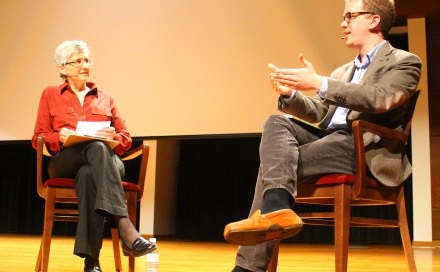
Wesley Hill at Calvin College

At best, some Christian colleges facilitate conversations on sexual identity openly and show that, as one Calvin College staff member put it, “we love our students.” At worst, some colleges try to hide these conversations as much as possible, sometimes to the extent of practicing overt censorship. I will not name individual institutions, but I’m aware of at least two cases in which Christian colleges have exerted power to prevent students from accessing unofficial student publications that include stories of sexual minority students. In those cases, some of the students did advocate for changing Christian teaching, but a primary purpose of the publications was for students to tell their stories. I also know of at least one Christian college at which the administration has prevented the student newspaper from publishing articles about sexual minority students online. I know for a fact that several of those articles did not advocate such a change in teaching. Any of this censorship not only throws sexual minority students, faculty, and staff under the bus, but it actually pushes people away from the traditional sexual ethic.

Continue reading