Friendship Roundup

Spiritual Friendship has published over 400 posts by now, all of which are related to friendship in one way or another. This “roundup” post simply tries to collect some of the posts which will be the most helpful in introducing new readers to the main ideas of this blog.

Friendship and covenant is an important theme in Scripture. Abraham, the great father of all who share his faith (Romans 4:16) is also called a friend of God (2 Chronicles 20:7; James 2:23). God “spoke to Moses face to face, as a man speaks to his friend” (Exodus 33:11). David and Jonathan form a covenant with each other (1 Samuel 18:3), and David says of Jonathan, “your love to me was wonderful, passing the love of women” (2 Samuel 1:26). And at the Last Supper, Jesus calls His disciples friends (John 15:15). Friendship has also been an important part of the Catholic Church’s pastoral approach to homosexual persons.

Spiritual Friendship in 300 Words provides a concise overview of how Ron Belgau learned about spiritual friendship from a 12th-century Cistercian abbot named Aelred of Rievaulx. In Three Kinds of Friendship, he explains the same ideas in greater depth, and in Some Theses on Friendship, he discussed some of the important themes he hopes to explore in this blog.

In Is Friendship an Unconditional Love? and The Problem of Monastic Cliques, Wesley Hill examines the dangers of exclusivity in friendship. In Friendship and the Scandal of Particularity, Ron Belgau responds by pointing out that there is a legitimate need for the specificity of Friendship. Gregg Webb explores some of the differences between the commitment of friendship and the commitment of marriage. Also relevant to this discussion are Eve Tushnet’s thoughts on Detachment in Friendship and Thomas Aquinas’s discussion of the relationship between friendship and charity.

The Catechism of the Catholic Church says that says that homosexual persons need the support of disinterested friendship.” This term is a frequent cause of confusion, which Ron Belgau helps to clear up.

Is there such a thing as Friendship at First Sight? Ron Belgau explores some of C. S. Lewis’s writings on this subject.

Finally, he shares about his own experiences with friendship, and Wesley Hill shares about his friendship with Ron Belgau.


Matt Jones at OnFaith: Avoiding Hypocrisy as the Church

matt_001Spiritual Friendship writer Matt Jones recently contributed to a series on sexuality and the church over at OnFaith, focusing on ways his current church community is modeling a traditional sexual ethic that avoids much of the hypocrisy found in more conservative churches. Some excerpts:

When I joined, I simply became a part of that redemptive movement. This is an enormous blessing, because — believe it or not — I really want to proclaim the gospel through ministry and advocacy. (And, as a white dude brimming with privilege, learning how to do this in a way that doesn’t reinforce inequality can be a challenge!) I want to be a Christian, and I want my church to urge the congregants on in our shared vocation of pursuing justice for the marginalized (which includes a sizable portion of the church population itself).

Often lgbt+ Christians are treated as if we have one job this side of Jesus’ return: don’t have gay sex. But, as Eve Tushnet so quotably stated, “You can’t have a vocation of no,” of only avoiding something. We need something to live for, and let me say that Christianity never makes more sense to me than when I am witnessing or participating in a Christian community that is unified toward imitating and proclaiming Jesus’ liberative gospel.

And:

It continues to amaze me how hard celibate lgbt+ people have to work to find space in churches that claim a more traditional sexual ethic. The social burdens experienced by sexual minorities in these communities vary widely, but usually include increased scrutiny and suspicion, painful comments from congregants who may or may not know about one’s sexuality, reduced ministry possibilities (e.g. I was once stripped of an internship and prevented from helping with a youth group because I wasn’t trying hard enough to be straight), insanely exhausting language policing,**** and at times, the general ache of being single in a culture that over-valorizes marriage and romance to the detriment of thechurch’s calling to be family.

I’m not sure how churches decided that the best ‘defense’ of the traditional sexual ethic is to place excessive burdens on those trying to abide by it and then fail to provide the support structures that would make such an ethic intelligible and healthy . . . but, well, here we are.

I believe the traditional sexual ethic is beautiful and good — I try to live according to it for a reason! — but I also believe that the way churches have approached the topic of human sexuality has largely failed to do any justice to the scope and nuance of the doctrine and has, in fact, done injustice to countless people who should have found a home and family within the church, and this requires sincere repentance.

Read the Whole Article at FaithStreet.

Matt Jones Podcast at Seminary Dropout

Recently, SF contributor Matt Jones was featured on Shane Blackshear’s podcast Seminary Dropout, which has previously featured (immensely cooler, he thinks) authors and speakers such as NT Wright, Walter Brueggemann, and Christena Cleveland.

matt_001

The podcast begins with some autobiography, then covers a range of topics touching on faith, sexuality, and how the ‘culture war’ mentality has deeply harmed the church’s community life and pastoral witness.

Check it out!

Thomas Aquinas: Is Charity Friendship?

From Summa Theologiae, IIa-IIae, question 23, article 1:

Icon of the Three Holy Hierarchs

Icon of the Three Holy Hierarchs: St. Basil the Great (left), St. John Chrysostom (center) and St Gregory of Nazianzus (right)

Objection 1. It would seem that charity is not friendship. For nothing is so appropriate to friendship as to dwell with one’s friend, according to the Philosopher (Ethic. viii, 5). Now charity is of man towards God and the angels, “whose dwelling [Douay: ‘conversation’] is not with men” (Daniel 2:11). Therefore charity is not friendship.

Objection 2. Further, there is no friendship without return of love (Ethic. viii, 2). But charity extends even to one’s enemies, according to Matthew 5:44: “Love your enemies.” Therefore charity is not friendship.

Objection 3. Further, according to the Philosopher (Ethic. viii, 3) there are three kinds of friendship, directed respectively towards the delightful, the useful, or the virtuous. Now charity is not the friendship for the useful or delightful; for Jerome says in his letter to Paulinus which is to be found at the beginning of the Bible: “True friendship cemented by Christ, is where men are drawn together, not by household interests, not by mere bodily presence, not by crafty and cajoling flattery, but by the fear of God, and the study of the Divine Scriptures.” No more is it friendship for the virtuous, since by charity we love even sinners, whereas friendship based on the virtuous is only for virtuous men (Ethic. viii). Therefore charity is not friendship.

On the contrary, It is written (John 15:15): “I will not now call you servants . . . but My friends.” Now this was said to them by reason of nothing else than charity. Therefore charity is friendship.

Continue reading

CRC Young Adult Leadership Task Force: Wesley Hill Interview

Today, the Young Adult Leadership Task Force of the Christian Reformed Church posted an interview of Wesley Hill by Brianna DeWitt:

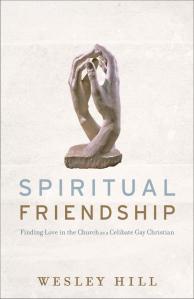
I recently interviewed Wesley Hill on his new book, Spiritual Friendship: Finding Love in the Church as a Celibate Gay Christian. He draws from Scripture and church tradition to show that friendship can be so much more than watching Netflix and eating pizza with people, but can instead be committed, deep, enriching relationships. The implications are profound for all people, regardless of relationship status. It is a needed reminder that the love in friendship is genuine and important, particularly for Christians who truly mean it when they say they desire close-knit communities.

SF book cover1.  How does spiritual friendship differ from other friendship? Should we aspire for all of our friendships to fall into this category?

Not necessarily. I like acquaintances and casual friendships as much as the next person. Certain friends you may meet once a month at the sports bar to watch a game together, and that’s great. But with certain friends, making a commitment to one another, to help nurture each other’s love of God and neighbor, can be an important step. It shifts friendship into the category of spiritual brother- or sisterhood. “There is a friend who sticks closer than a brother,” Scripture says, and that’s something to treasure and nurture when it happens.

2.  As a celibate gay Christian, you write that part of your desire to rediscover the true intention of friendship was to avoid a lonely life–and yet, you repeatedly emphasize the importance of friendship for all people–gay, straight, single, married, and otherwise. Why is friendship uniquely important, even for people who have spouses and children? 

One of the myths many Christians have believed in recent years is that marriage and family life is the pinnacle of human love. I remember getting that message loud and clear in my church’s youth group: save sex for marriage, and then you’ll live happily ever after! But of course romance and marriage shouldn’t be thought of that way because that places far too much of a burden on one person to be everything to another. Having spiritual friends can be an important reminder to each spouse that they not only belong to one another, they belong to the church, to their community, as well.

Check out the whole interview.

Western Seminary: Three Cheers for Celibacy

chad-hallChad Hall is the Director of Coaching for Western Seminary and also serves as a leadership coach for ministry and corporate clients through his role as Partner with Coach Approach Ministries and iNTERNAL iMPACT. In a recent blog post, “Three Cheers for Celibacy,” he offers three reasons the church needs to treat celibacy as more normal than marriage, and three ideas for promoting celibacy in contemporary culture.

Sometimes in the life of the church we need to reclaim a forgotten or dormant teaching. My sense is that now is such a time and that the teaching we need to dust off and put into practice is celibacy.

Celibacy is not a very popular idea. We Protestants see the Catholic Church overdoing it by not allowing priests to marry and we kind of recoil at the idea. Not marrying and not having children (and, let’s face it, not having sex) just seems weird to most of us. Perhaps this is why we’ve normalized marriage and ostracized celibates.

The strongest case for celibacy comes from the pages of the New Testament. Jesus did not marry. Neither did Paul. In fact, Paul encouraged the earliest believers to try and resist the urge to marry for the sake of the kingdom. He simply believed (and taught) that it was better not to marry. If we take the New Testament seriously, perhaps we should take celibacy more seriously. And by “take seriously” I mean teach that celibacy is the norm and marriage is the exception.

4-margot-pandone

Why should the church reverse polarity on the marriage-celibacy issue? In addition to the unchanging witness of Scripture, I see three good reasons we in the church need to treat celibacy as more normal than marriage.

Read the whole article at Western Seminary’s Transformed Blog

Matthew Loftus on Wesley Hill’s Spiritual Friendship book

SF book coverMatthew Loftus has written a review of Wesley Hill’s new Spiritual Friendship book for MereOrthodoxy. Titled “Material Dimensions of Spiritual Friendship,” Loftus’s essay offers a brief summary of the book, and explores three questions about spiritual friendship, culture, and mission that arise both from his own experience as a doctor in inner city Baltimore and from the challenges Wesley raises in the book.

Wesley Hill’s new book Spiritual Friendship is not an easy read. It’s short, yes, coming in at under 150 pages. But in that space Hill manages to be disquieting on a subject that is often taken for granted–specifically, the question of how we form and maintain intimate friendships. Part historical survey, part Biblical analysis, and part personal reflection, Spiritual Friendship manages to be informative and insightful but also unnerving and challenging. Rather than a full review, I’d like to briefly summarize the themes in the book and then respond to some of the questions that it raises. Since Wesley grounded his exploration of friendship in his experiences and friendships, I’d like to do the same as I recount some of what my wife and I have learned from our time in inner-city Baltimore.

The first part of the book looks at the situation we are in with regards to friendship, using the author’s own experience as a celibate gay Christian as a jumping-off point for how much more anemic our honor of friendship is now–particularly same-sex friendships– than they apparently used to be. He assigns as much blame for the decline in friendship’s power and privilege to the modern instinct that boils every interaction down to its sexual nature as he does to the reactionary traditionalism that wants to elevate marriage well beyond all other human relationships. What we’re left with nowadays is friendship as purely voluntary, thus making the idea of intimacy and mutual comfort wholly dependent on the whims of our friends. Wesley’s Christianity Today cover story from last year covers many of these same themes in a more compressed fashion, which lead to a great discussion of vowed friendships in particular here at Mere Fidelity.

In the second half of the book, Wesley gets more personal as he looks at how difficult these intimate friendships are to build and maintain. Regardless of one’s stance on questions of gay identity, it is hard not to be moved by the quandary he puts forth: gay and lesbian Christians who choose to honor the Biblical teaching by remaining celibate (and all Christians who don’t marry) are shut out of the intimate companionship that marriage provides–erotic or not–and so far have been left to their own devices to find ways to ameliorate the attendant loneliness and isolation they face. He relates the moving story of how one particular friendship fell apart and concludes the book with a chapter about how his local church has been trying to find ways to foster friendship–and how powerful the Eucharist in particular can be in unifying us as a community. However, these relationships are still incredibly vulnerable to the mobility many of now experience as we transition from wherever we grew up to wherever we study to wherever we find a job thereafter. While never really resolving the tension inherent in this mobility, he emphasizes the importance of friendships that require serious commitment to one another, particularly as they give us the opportunity to suffer together and share in the burdens that come to all believers–not just the celibate.

There’s obviously a lot more in the book than what I’ve summarized above, but I want to emphasize that the book left this reader feeling incomplete, asking more questions than when I started. I suspect that this is by design, though it is a book that stands on its own even as it complements the body of work accumulating at the blog Wesley helped to start (https://spiritualfriendship.org/). The three lines of thought I’d like to explore are: What else has fueled our cultural denigration of friendship besides our changing cultural mores, and can we change these upstream factors? How do we think about intimate spiritual friendships across class lines, and is there a particular call to suffer there? Finally, to what degree does our understanding of the local church and its mission affect how we forge our friendships–or is it the other way around?

Read the full review.

Melinda Selmys at Theologues

Over at Theologues, Melinda Selmys asks the question, “Is There a Place for the Transgender in the Church?

transPhoto by Jeffrey Beall/flickr. Cropped.

I am a Christian, and I experience gender dysphoria. I’m not transgender—I identify as a woman—but I experience a strong sense of discord between my female body and my interior sense of self, my gender identity.

For many Christians, transgender rights seem like the next wave of assault on traditional marriage and biblical sexuality. The idea that anyone would want to alter their “God-given” sexuality, using hormones, surgery or other means to become a member of the opposite sex, seems grotesque. More alarmingly, it seems to fly in the face of Biblical wisdom, which describes the creation of man: “male and female He created them.” (Gen. 1:27)

Trans people constitute a very small minority of the human population, so it’s easy for a discourse to develop that is concerned solely with political or philosophical considerations. I’m not going to claim that those aspects of the question aren’t important. There is a rich biblical tradition surrounding sexuality and gender; questions about how men and women ought to conduct themselves have concerned Christian writers since St. Paul. This tradition cannot merely be dismissed. Problems arise, however, when the tradition is discussed without reference to the real human beings involved.

Read the whole essay at Theologues.

John Piper on Being Single in Christ

An old (2007) sermon from John Piper: “Single in Christ: A Name Better Than Sons and Daughters.”

I will start and end with my main point and, in the middle, cover a wide terrain of Scripture to support it. My main point is that God promises those of you who remain single in Christ blessings that are better than the blessings of marriage and children, and he calls you to display, by the Christ-exalting devotion of your singleness, the truths about Christ and his kingdom that shine more clearly through singleness than through marriage and childrearing. The truths, namely,

  1. That the family of God grows not by propagation through sexual intercourse, but by regeneration through faith in Christ;
  2. That relationships in Christ are more permanent, and more precious, than relationships in families (and, of course, it is wonderful when relationships in families are also relationships in Christ; but we know that is often not the case);
  3. That marriage is temporary, and finally gives way to the relationship to which it was pointing all along: Christ and the church—the way a picture is no longer needed when you see face to face;
  4. That faithfulness to Christ defines the value of life; all other relationships get their final significance from this. No family relationship is ultimate; relationship to Christ is.

To say the main point more briefly: God promises spectacular blessings to those of you who remain single in Christ, and he gives you an extraordinary calling for your life. To be single in Christ is, therefore, not a falling short of God’s best, but a path of Christ-exalting, covenant-keeping obedience that many are called to walk.

Watch the video above, or check out the whole sermon at Desiring God.

Wartburg Watch: Even Celibacy Is Not Enough for Some Christians

Washed and WaitingOver at a blog called The Wartburg Watch, there’s a nice discussion of Spiritual Friendship and some of the challenges we’ve received from conservative critics. The post (and the blog) may be of interest to some of our readers.

Years ago, when my little daughter was suffering from brain tumor, I felt overwhelmed with the difficulties of managing my other children while coping with my own feelings of overwhelming pain for my daughter and fear for her future. My husband had to maintain his job so that we had the insurance to help pay for the medical bills. I felt quite lonely even though I had wonderful friends who supported me, helping with my other children and making meals for us. How does one explain the pain and fears to others who are not experiencing it?

I was directed to a group that dealt with the difficulties of having a child with a serious brain tumor. I found great comfort in the group as we discussed our issues. Children’s Hospital in Dallas provided professionals to help us work through all sorts of things. It was so comforting to be with a group of people who got it even if I didn’t say a word.

I grew to understand the importance of the support such groups offer. We formed friendships and held each other up through the inevitable pain and sorrows that arose.

That is why I was excited when I learned about the development of Spiritual Friendship amongst celibate gays. Before I go any further, I would ask that we keep this discussion centered around those gay Christians who have decided that they believe they should remain celibate. This is important to this post because I want to show that even when individuals make decisions that should be acceptable to conservative Christian, they still get criticized.

Check out the whole post.